
Deer move at the two ends of the day, which is exactly when a scope has the least light to work with. The last twenty minutes of legal shooting are the twenty minutes that decide most crossbow seasons, and a scope that looks crisp at noon can turn into a grey tunnel by the time a doe steps out. The single figure that predicts how the best crossbow scope behaves in that light is exit pupil, and it is simple arithmetic rather than marketing.
Take the objective diameter in millimetres and divide by the magnification. A 32 mm objective at 4x gives an 8 mm exit pupil, a 24 mm objective at 5x gives 4.8 mm, and a 32 mm objective at 7x gives 4.6 mm. A dark-adapted eye opens to roughly 7 mm, so any scope delivering 7 mm or more is giving your pupil everything it can accept. Past that point a bigger objective does not brighten the picture.
Lens coatings decide how much of the light that enters actually reaches your eye. A fully multi-coated lens with 16 layers will pass more usable light than a single-coated one of the same size, which is why two 32 mm scopes can look very different at dusk. Illumination answers a different problem: it does not make the deer brighter, it makes the aim point readable against a dark body, and a reticle lit too hot will flare and wash out the very target you are trying to see.
The rest of the choice is about matching the scope to your bow’s speed. Crossbow reticles are calibrated to a velocity band, and a scope set for 300 to 460 fps will not put its aim points where your bolt lands if the bow shoots outside that range. Check the speed band, decide whether you want a fixed magnification or a variable, then confirm the tube diameter and the rings you already own before you buy the best crossbow scope for deer hunting you can afford.
Quick Picks
Best Overall: HAWKE XB1 1.5-5×32 — 8 mm exit pupil at 5x and a 250–425 fps calibration band
👉 Choose the Hawke XB1 Scope on Amazon
Best Budget: CVLIFE 1.5-5×32 Rangefinder Reticle — 300–460 fps calibration with rings in the box
👉 Grab the CVLIFE 1.5 to 5×32 Scope on Amazon
Best Fixed Power: HAWKE XB 3×32 — one aim point, fixed at 340 fps, with 11-layer coated glass
👉 Take the Hawke XB 3×32 Scope on Amazon
Best Rangefinding: TenPoint Vision HD 3-12x — a 5 to 1,100 yard laser paired to five ballistic profiles
👉 Pick the TenPoint Vision HD Scope on Amazon
Comparison Table
| Product Name | Best For | Price Range | Check Price on Amazon |
|---|---|---|---|
| HAWKE XB1 1.5-5×32 Crossbow Scope | Low light on a tight outlay | Mid | See the Hawke XB1 |
| CVLIFE 1.5-5×32 Rangefinder Reticle | A first scope with rings included | Budget | Review the CVLIFE 1.5 to 5×32 |
| HAWKE XB 3×32 Illuminated Scope | A bow that shoots near 340 fps | Budget | Open the Hawke XB 3×32 |
| Hawke XB30 Pro 1-5×24 Scope | Matching one reticle to two bows | Mid | Check the Hawke XB30 Pro |
| Bear X Wire Reticle Speed Comp Scope | Fast acquisition in thick cover | Budget | View the Bear X Speed Comp |
| TenPoint Vision HD 3-12x Scope | Ranging and drop compensation in one unit | Premium | Find the TenPoint Vision HD |
| CVLIFE 2-7×32 Crossbow Scope | Reaching across open ground | Budget | Inspect the CVLIFE 2 to 7×32 |
Buyer’s Guide
1. Work Out the Exit Pupil Before Anything Else
Divide the objective lens diameter by the magnification you actually hunt on. A 32 mm objective at 4x delivers an 8 mm exit pupil, and a 24 mm objective at 5x delivers 4.8 mm. A dark-adapted eye takes in about 7 mm, so the first scope is already past what your pupil can use while the second is below it. Hunt on the lowest magnification you can and the same scope gets brighter, because the objective stays the same while the divisor shrinks.
2. Read the Speed Band on the Reticle
Crossbow reticles carry aim points for 20, 30, 40 and 50 yards, and those points only line up if the bow shoots inside the calibrated band. Bands here run from 250–425 fps up to 300–460 fps, and the widest is a dial that spans 215–450 fps. If your bow sits outside the band, the lower aim points will land high or low and no amount of zeroing fixes it. Check the bow’s chronographed speed with the bolt you hunt with, then compare it against the band.
3. Decide Between Fixed and Variable Power
A fixed 3×32 is one aim point, one setting and nothing to move when a deer appears, which suits a hunter who knows the ground and shoots inside 40 yards. A variable 1.5–5x lets you drop to 1.5x in thick cover and turn up to 5x across a field, in exchange for one more thing to check. A 3–12x digital scope goes further and adds rangefinding, but it also adds a battery and a menu. Pick the amount of adjustment you will actually use under pressure.
4. Match the Tube to the Rings You Own
A 1 inch tube needs 1 inch rings and a 30 mm tube needs 30 mm rings, and the two are not interchangeable without an adapter. A 30 mm tube also carries more internal adjustment travel, which matters on a crossbow rail that sits high above the bore. Check what the scope ships with: one here includes 20 mm rings, one includes 21 mm rings, and the rest arrive bare. Buying rings twice is the most common avoidable outlay in this category.
One Mistake to Avoid: Cranking the Illumination to Maximum
The usual error is turning the rheostat to its brightest setting at last light because a brighter dot feels easier to see. In practice a hot reticle blooms against a dark deer, washes out the outline behind it and destroys the contrast you bought the scope for. Set the illumination just bright enough to read against the body, then drop it one more step. On a moonlit night the etched reticle alone is often clearer than any lit setting.
Best crossbow scope for deer hunting: 7 Clear-Optic Options for Low-Light Visibility
Seven scopes, and the spread runs from a fixed 3×32 with one aim point to a digital unit that ranges to 1,100 yards and writes video to a card. Each entry gives the magnification, the speed band, the tube diameter and the objective figure as the maker publishes them, then says where the scope stops working after sunset. Where two sources disagree on a specification, the gap is named rather than smoothed.
1. HAWKE XB1 1.5-5×32 Shockproof Crossbow Scope
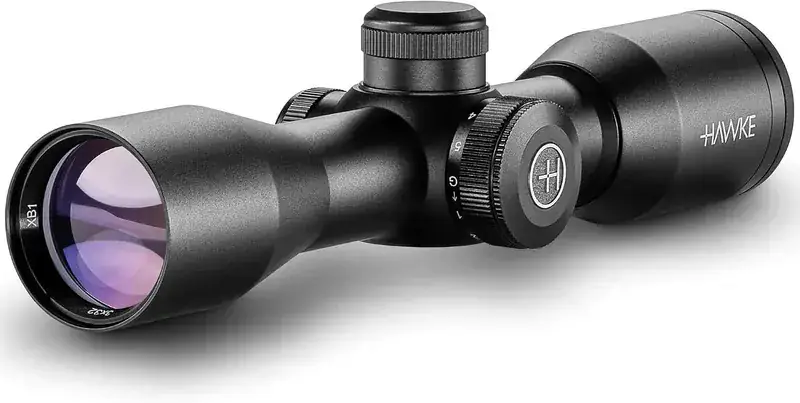
Best for: A hunter who wants a bright sight picture and a proven speed band without a battery menu.
- 1.5–5x Magnification: on a 32 mm objective for an 8 mm exit pupil at 5x.
- 250–425 fps Calibration: the band the reticle is built around.
- 1 in Mono-Tube: with capped low-profile turrets and a fast-focus eyebell.
- XB1 SR Reticle: a glass-etched illuminated reticle, model 12221.
- 32 mm Objective: an 8 mm exit pupil at the 5x setting.
Pros:
- The 32 mm objective keeps a usable pupil at every magnification in the band.
- Capped turrets cannot be knocked off zero by a branch on the walk in.
- A 250 fps floor covers slower bows that most rival reticles ignore.
Cons:
- The 425 fps ceiling leaves fast modern bows outside the calibration.
- A 1 inch tube carries less adjustment travel than a 30 mm chassis.
- Nothing is published about eye relief, so mounting depth is trial and error.
2. CVLIFE 1.5-5×32 Crossbow Scope with Rangefinder Reticle
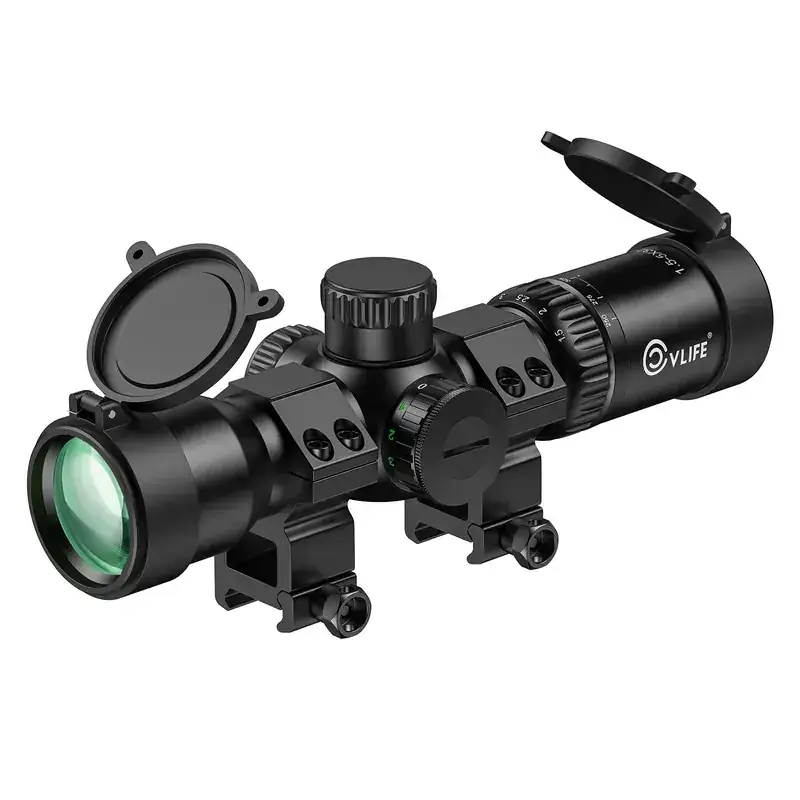
Best for: A first crossbow scope where rings in the box keep the whole setup to one order.
- 1.5–5x Magnification: on a 32 mm objective in a 30 mm tube.
- 300–460 fps Calibration: a wider band than the two Hawke variables here.
- 20–100 Yard Reticle: holdover marks for the whole practical range.
- Red and Green Illumination: 5 brightness steps on a glass-etched reticle.
- 8.2 in Overall Length: with 20 mm rings, caps and batteries included.
Pros:
- Rings, caps and batteries arrive together, so nothing else has to be bought.
- The 460 fps ceiling covers the fastest production hunting crossbows.
- A 30 mm tube gives more elevation travel on a high-mounted rail.
Cons:
- No eye relief figure is published for a scope with this much magnification range.
- The 1.5x low end and the illumination dial compete for the same hand position.
- Green and red share one rheostat, so the setting has to be re-checked after a swap.
Dial in the CVLIFE 1.5 to 5×32 on Amazon
3. HAWKE XB 3×32 Illuminated Crossbow Scope
Best for: A hunter with a 340 fps bow who wants one aim point and no decisions at dusk.
- Fixed 3×32: 10.7 mm exit pupil at a single magnification.
- 340 fps Calibration: the speed the reticle is permanently set for.
- 20 Yard Zero: with aim points every 10 yards out to 70 yards.
- 11-Layer Coatings: fully multi-coated glass on the H2 optical system.
- 11.04 oz: on a 1 inch tube with 10.2 cm of eye relief.
Pros:
- Nothing to adjust, so the shot sequence is glass, safety, trigger.
- A 10.7 mm exit pupil is the largest figure in this group by a wide margin.
- Eleven-layer coatings hold contrast on a grey evening better than plain glass.
Cons:
- Bows outside the 340 fps calibration will not match the lower aim points.
- Fixed 3x is more magnification than thick cover at 15 yards wants.
- No parallax adjustment is offered, only the fixed factory setting.
Zero the Hawke XB 3×32 on Amazon
4. Hawke XB30 Pro 1-5×24 Crossbow Scope
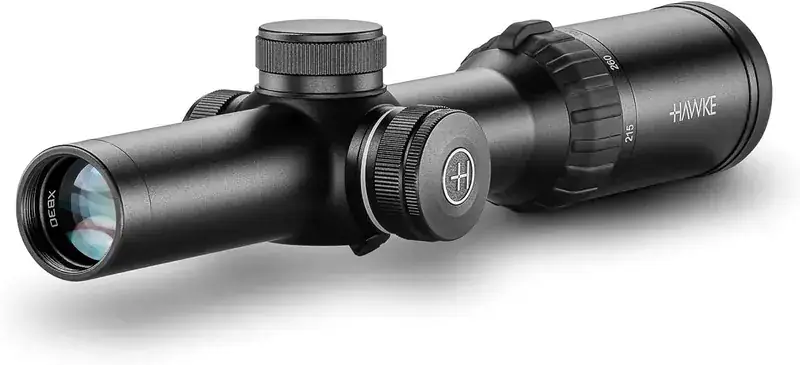
Best for: One scope moved between two bows that shoot very different speeds.
- 215–450 fps Speed Selector: the widest band here, set by a rubber dial.
- 1–5x on a 24 mm Objective: 4.8 mm exit pupil at the top setting.
- 30 mm Mono-Tube: with 210 MOA of elevation and windage travel.
- 16-Layer Coatings: fully multi-coated on the System H2 optics.
- 16.5 oz and 10.1 in: with 76 mm of eye relief.
Pros:
- The speed dial means one scope can serve a backup bow without a re-zero.
- A stepless rheostat gives any brightness level rather than five fixed steps.
- 210 MOA of travel leaves room to shim a rail that sits high.
Cons:
- The 24 mm objective is the smallest here, so it needs the low end after sunset.
- Illumination is red only, so there is no green option for a colour-blind shooter.
- Parallax is fixed at 50 yards, which is coarse for a 5x top end.
Set the Hawke XB30 Pro on Amazon
5. Bear X Wire Reticle Speed Comp Crossbow Scope
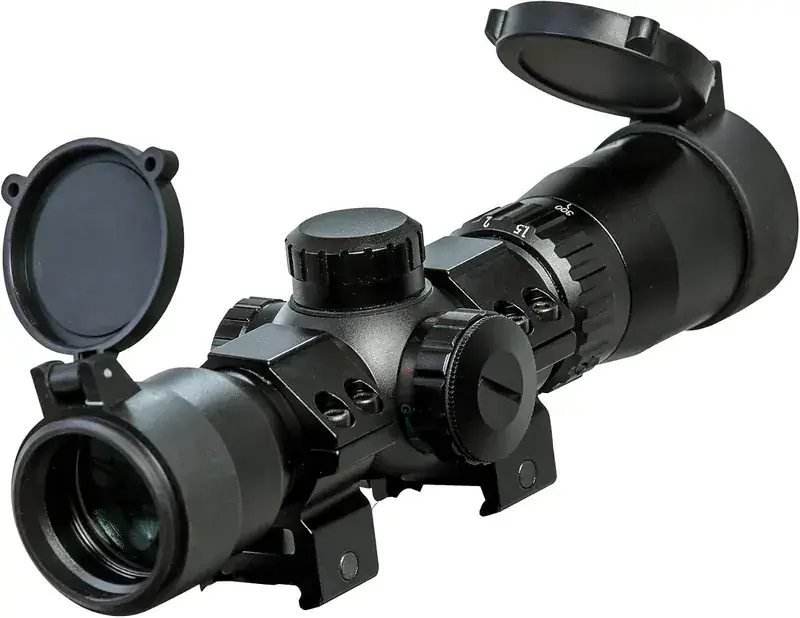
Best for: A shooter who wants the reticle to come up fast in heavy cover.
- 1.5–5x Magnification: the variable range the product page lists.
- 4-Line Reticle: a wire design with 4 marks to sort under pressure.
- 205–430 fps Speed Dial: the band the reticle is calibrated against.
- 2 Illumination Colours: red and green on one rheostat.
- 1.2 lb Aluminium Body: on a Picatinny mount, fogproof and waterproof.
Pros:
- Four lines is faster to read than a stacked Christmas tree in thick timber.
- An aluminium body at 1.2 lb survives a knock without shifting zero.
- Both illumination colours are offered at this end of the range.
Cons:
- No objective diameter appears anywhere on the retail page.
- Bear lists a 1–5×24 frame elsewhere, which does not match the 1.5–5x title.
- A wire reticle is thicker than etched glass and covers more of a deer at range.
Fit the Bear X Speed Comp on Amazon
6. TenPoint Vision HD 3-12x Digital Rangefinding Crossbow Scope
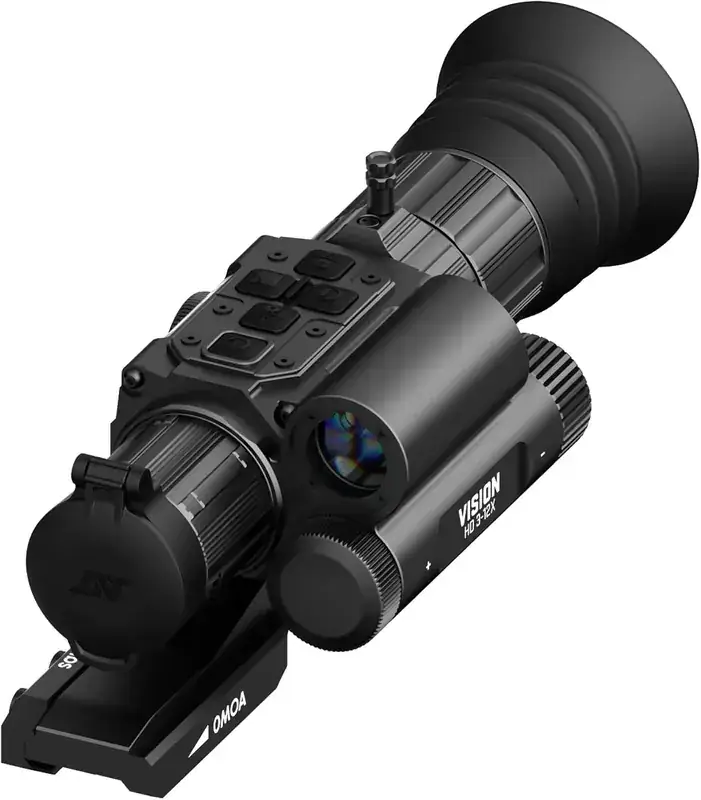
Best for: A hunter who wants the range and the drop solution in the same eyepiece.
- 3–12x Digital Zoom: a screen rather than a glass image.
- 5 to 1,100 Yard Laser: an integrated rangefinder inside the housing.
- 5 Ballistic Profiles: pre-loaded curves for TenPoint bows.
- 30 Yard Zero: set once, then compensated out to 100 yards.
- 10 Hours of Battery: from two supplied rechargeable cells.
Pros:
- Ranging and the aiming solution arrive together, so no separate laser is needed.
- Five profiles plus a custom curve cover a bow that is not on the stock list.
- A recoil-triggered recording mode captures the shot without a second button.
Cons:
- A digital eyepiece depends on battery state in a way glass never does.
- The image lags a glass scope in the last minutes of light.
- At 1.15 lb it is the heaviest optic here before the mount is added.
Range with the TenPoint Vision HD on Amazon
7. CVLIFE 2-7×32 Crossbow Scope with 21mm Rings
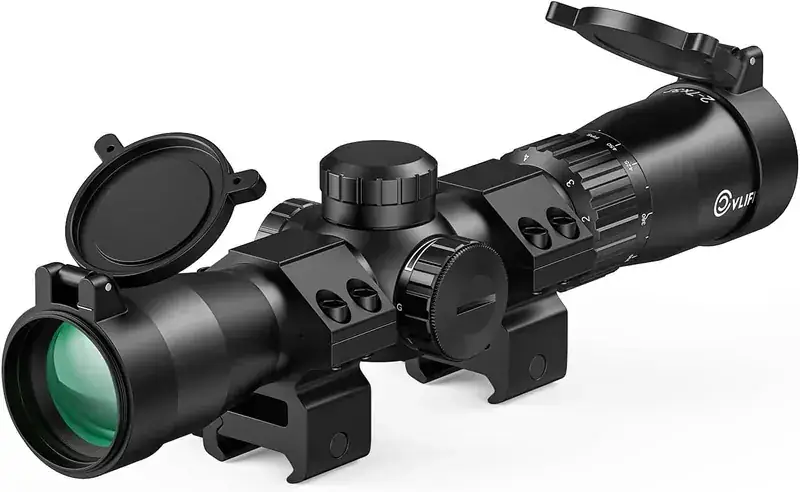
Best for: Open-ground hunting where the deer may hold up at 60 yards.
- 2–7x Magnification: the highest top end here short of the digital scope.
- 275–450 fps Speed Ring: dialled to the bow before the first shot.
- 20–100 Yard Reticle: pre-zeroed at 50 yards.
- 95 Percent Light Transmission: through a fully multi-coated green lens.
- 80–90 mm Eye Relief: with 21 mm rings and flip caps included.
Pros:
- The 7x top end resolves a deer against a hedgerow at 60 yards.
- A 50 yard zero puts the mid-range marks where most shots happen.
- Included rings and caps keep the first setup to one purchase.
Cons:
- The detail field lists a 30 mm objective against a 32 mm title.
- 2x at the bottom is more magnification than a 15 yard shot in cover wants.
- The 21 mm rings will not fit a rifle-style Picatinny rail without an adapter.
Glass with the CVLIFE 2 to 7×32 on Amazon
Frequently Asked Questions
Q1: What magnification makes the best crossbow scope for deer hunting in low light?
A: Lower magnification is brighter for the same objective, because exit pupil is the objective diameter divided by the magnification. A 32 mm objective at 4x gives 8 mm, which is more than a dark-adapted eye can use; the same scope at 7x gives 4.6 mm, which is less. If you hunt the last thirty minutes, set the scope to its lowest power and rely on the lit reticle rather than on turning the magnification up.
Q2: Does an illuminated reticle help me see a deer at dusk?
A: It helps you place the shot, not find the deer. Illumination lights the aim point so it stays readable against a dark body, which matters most when the animal is in shadow. It cannot brighten the image, and set too high it blooms and hides the outline. Keep the setting low enough that the reticle reads without glowing, and let the objective and the coatings do the work of gathering light.
Q3: What crossbow speed do I need to know before buying a scope?
A: The chronographed speed of your bow with the bolt and point you intend to hunt, not the figure in the brochure. Reticles are calibrated to a band such as 250–425 fps or 300–460 fps, and a bow outside the band will not match the lower marks. Borrow a chronograph or ask a shop to read it, then compare against the band on the scope’s page before you order.
Q4: Will a 30 mm tube make a scope brighter than a 1 inch tube?
A: Not directly. Tube diameter changes how much internal adjustment travel the scope carries and how the mount sits on the rail, not how much light reaches your eye. Light gathering is set by the objective diameter and the coatings. A 30 mm tube earns its place on a crossbow rail because you get more elevation travel, but do not expect the image to brighten just because the tube is wider.
Q5: Can I use a crossbow scope on a rifle or a rifle scope on a crossbow?
A: Neither swap works well. A crossbow reticle is calibrated for a slow, heavy projectile with a steep trajectory, so its aim points mean nothing on a rifle. A rifle scope is not built for the bidirectional recoil of a crossbow, which can shake a reticle loose. Mount a dedicated crossbow optic on the crossbow and keep the rifle glass on the rifle.
Final Verdict
If you want the best crossbow scope for deer hunting that stays readable in the last twenty minutes of light, don’t overthink it—these are already:
✔ Exit pupil worked out for every magnification here
✔ Speed bands quoted as a range rather than a single figure
✔ Objective and tube diameters named where the page publishes them
Best Overall – HAWKE XB1 1.5-5×32 Shockproof Crossbow Scope
Best Budget – CVLIFE 1.5-5×32 Crossbow Scope with Rangefinder Reticle
Best Fixed Power – HAWKE XB 3×32 Illuminated Crossbow Scope
Best Rangefinding – TenPoint Vision HD 3-12x Digital Rangefinding Crossbow Scope
