

A feeding station is a commitment the day the first bag goes in: the herd finds it inside a week, patterns around it inside a month, and judges the hardware for seasons. The best deer feeder for a managed property is therefore a math problem before it is a purchase — hopper capacity against refill trips, timer control against gravity simplicity, and the mounting reality of the site you actually own. Choose by the chore it saves, not by the biggest number on the tag.
The field splits three ways by mechanism. Broadcast deer feeders run a timer and spinner that meter corn on a schedule you set — control at the cost of batteries, electronics, and varmint mechanics. Gravity feeders skip the machinery entirely: a hopper, a tube or three, and feed on the animals’ schedule — the class that survives neglect and power outages alike. Protein feeders complete the deer feeder field for the grow program, where corn hardware cannot handle the pellet class at all.
Capacity is chore math before it is a number. A 30-gallon station suits a small plot and a weekly walk; the 200–300 pound class buys weeks of autonomy; the 400-plus steel lanes exist for high-traffic ground where a monthly refill is the point. The install belongs in the same math — tripods need level ground and anchoring, post-mounted boxes need a dug hole and a supplied post, and a 73-pound steel kit is a two-person job. And every class needs a varmint answer, because open feed access serves raccoons and hogs as readily as the herd: the plan you make for them decides whether the station feeds deer or the county.
Quick Picks
Best Overall: Moultrie 250 Lb Pro Hunter III Tripod Feeder — ten-event app scheduling on a 250 lb broadcast hopper.
👉 Program the Moultrie on Amazon
Best Value: American Hunter 30-Gallon Nesting Hopper Gravity Feeder (AH-225GRAV) — maintenance-free gravity feed at the lowest hopper-class ask.
👉 Deploy the American Hunter on Amazon
Best Premium: Banks Outdoors Feedbank 300 — the biggest sealed hopper on a fixed post mount.
👉 Mount the Feedbank on Amazon
Best Gravity Capacity: Boss Buck 200 lb Gravity Deer Feeder — 200 pounds of no-timer feed on tall galvanized legs.
👉 Set the Boss Buck on Amazon
Comparison Table
| Product Name | Best For | Price Range | Check Price |
|---|---|---|---|
| Moultrie 250 Lb Pro Hunter III Tripod Feeder | App-controlled broadcast | Mid | Check Price |
| American Hunter 30-Gallon Nesting Hopper Gravity Feeder (AH-225GRAV) | Maintenance-free gravity value | Mid | Check Price |
| Banks Outdoors Feedbank 300 | Premium fixed station | Premium | Check Price |
| Boss Buck 200 lb Gravity Deer Feeder | Gravity capacity lane | Premium | Check Price |
| HECASA 450 lb Steel Gravity Deer Feeder | Steel bulk capacity | Mid | Check Price |
| ASF All Seasons Feeders EZ Deer Tree Protein Feeder | Protein-feed program | Mid | Check Price |
| On Time 71540 Buckeye Gravity Feeder | Proven no-timer veteran | Mid | Check Price |
Buyer’s Guide
Size the hopper to the refill trip you are willing to make. Capacity is chore math: a 30-gallon class station feeds a small plot for a couple of weeks, the 200–300 pound class stretches toward a month, and the 400-plus steel lanes turn refilling into a monthly errand. But capacity you cannot lift is capacity you resent — a 73-pound steel assembly with a foot kit sold separately is a two-person, bring-the-tools install, while a post-mounted box needs an 8-foot 4×4 and a dug hole before the first bag pours. Count the bags, the walk, and the hardware on your own ground before the order prints.
Match the feed class to the hardware, not the other way around. Broadcast spinners meter shelled corn and throw it on a schedule — the control lane — but they jam on protein pellets, chew batteries, and broadcast for every raccoon in the county. Gravity stations run anything dry, never need a battery, and keep feed accessible around the clock; their cost is selectivity — the herd eats, and so does everything else on four legs. Protein programs belong in the dedicated pellet stations with adjustable-flow ports, because freshness and flow geometry decide whether the supplement actually gets eaten. Buy the mechanism your feed demands first, then argue about features.
Place the station like it is permanent, even when it is not. Feeder placement trains movement more than any attractant: stations work best 100-plus yards from stand sites on natural travel corridors, with the throw pattern or tube access clear of fence lines and water. Sun and rain decide hopper life — covered, sealed hoppers outlast open tops by seasons — and varmint defense is a site decision the product page rarely makes for you. Check the power and accessory lists against your plan before ordering, and confirm who actually sells and ships at checkout, because heavy listings rotate sellers more than any other class this site tracks.
One Mistake to Avoid: Buying Capacity You Cannot Install
The biggest hoppers fail at the install, not in the field. A 450-pound-capacity steel feeder arrives as a 73-pound kit with anchoring hardware explicitly excluded; a 300-pound box needs its post bought, dug, and set plumb before it earns its keep; and a tripod feeder with a loaded hopper is a two-person lift every time it moves. Landowners order by capacity, discover the install on delivery day, and spend a season with a heavy hopper parked by the barn. Plan the site, the tools, the anchoring, and the fill route first — then buy the biggest capacity your plan can actually stand up.
Best Deer Feeder: 7 Durable Options for Landowners Managing Feeding Stations
The seven stations below sort the field by mechanism and scale — an app-controlled broadcast tripod, two gravity tripods, a post-mounted premium box, a 450-pound steel bulk feeder, a protein-class hanger, and a veteran no-timer barrel. Each card sticks to what the hardware does: capacities, mounts, ports, and power, with exclusions and naming quirks flagged where they change the buying decision.
1. Moultrie 250 Lb Pro Hunter III Tripod Feeder
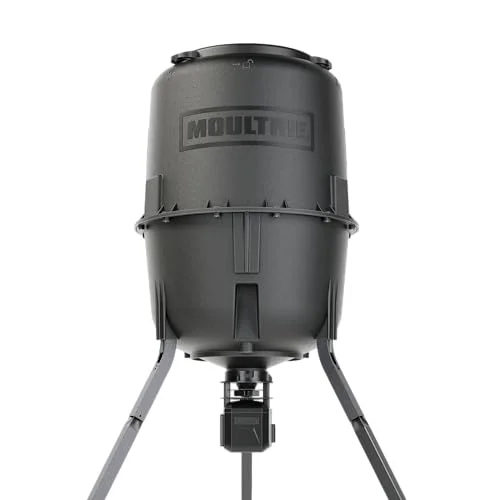
Best for: A managed broadcast station you program from the truck and refill every few weeks.
- 250 lb hopper: roughly three weeks of corn between refills for a steady herd — capacity that anchors a standing station rather than a weekend plot.
- Bluetooth app control: program up to ten feed events a day from the truck, so schedule changes never require a ladder climb or pulling the unit down.
- 360° broadcast spinner: throws feed in a full circle, spreading the herd out instead of stacking every deer into one throw direction.
- 6V rechargeable power with solar port: runs on a rechargeable battery sold separately, and the solar port keeps it topped off through the season — add the cell to the total.
- Tripod build: the elevated frame keeps the spinner clear of ground cover and the fill lid at working height.
Pros:
- Ten-event app scheduling from the truck
- 250 lb hopper on a 360° throw
- Solar port for season-long power
Cons:
- Battery sold separately — add it to the total
- Spinner class feeds raccoons and hogs too — plan varmint defense
- Electronics add a cold-weather failure point the gravity class does not carry
Schedule the Moultrie on Amazon
2. American Hunter 30-Gallon Nesting Hopper Gravity Feeder (AH-225GRAV)
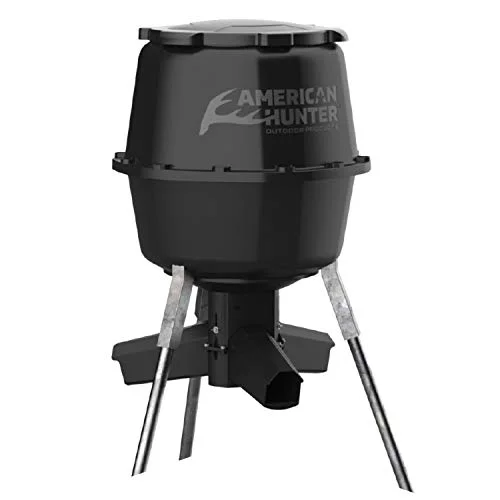
Best for: A set-and-forget corn station that runs on no power and no programming.
- 30-gallon nesting hopper: roughly two hundred pounds of corn under a lid geometry that sheds rain instead of pooling it.
- Three 8-inch feed tubes: access on three sides of the tripod, so several deer feed at once and one dominant animal cannot hog a single lane.
- All-gravity mechanism: no timer, no spinner, no battery — feed is available around the clock and the station runs through power outages untouched.
- Maintenance-free design: nothing to program or charge through the season, which is the whole point of the class.
- Tripod legs: hold the tubes off wet ground and keep the hopper at a comfortable fill height.
Pros:
- Runs with zero power or electronics
- Three-sided access cuts crowding
- Lowest ask of the hopper class here
Cons:
- No schedule control — feed flows day and night
- Open tubes serve raccoons as readily as deer
- No varmint cage in the package
Go gravity with the American Hunter on Amazon
3. Banks Outdoors Feedbank 300
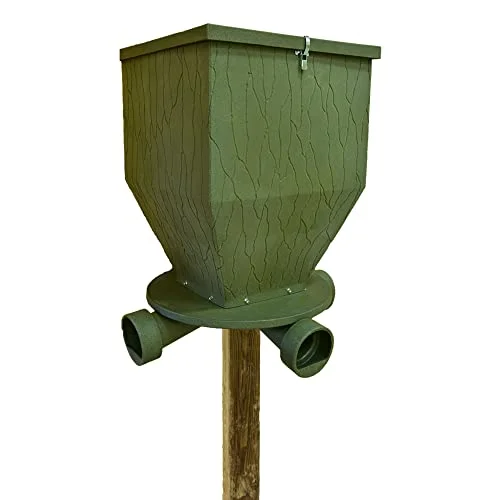
Best for: A permanent feeding site where refills come from the truck bed.
- 300 lb sealed hopper: the biggest covered capacity here — refills stretch toward a month and the feed stays dry under the covered top.
- Adjustable feed ports: tune the drop rate to the herd and close the box down when pressure drops.
- Post-mount install: runs on an 8-foot 4×4 you supply — buy the post, dig the hole, and set it plumb before the first pour.
- Fixed-station footprint: once the post is set, the box is permanent — this is the feeder for a site you have already chosen.
- Covered-top design: rain sheds off the lid instead of finding the feed, the detail that decides whether corn spoils mid-cycle.
Pros:
- Biggest sealed capacity on this list
- Adjustable ports tune the flow
- Covered top keeps feed dry
Cons:
- Post and installation are on you
- Fixed mount — no relocation once set
- Top-tier ask even after the live drop
4. Boss Buck 200 lb Gravity Deer Feeder
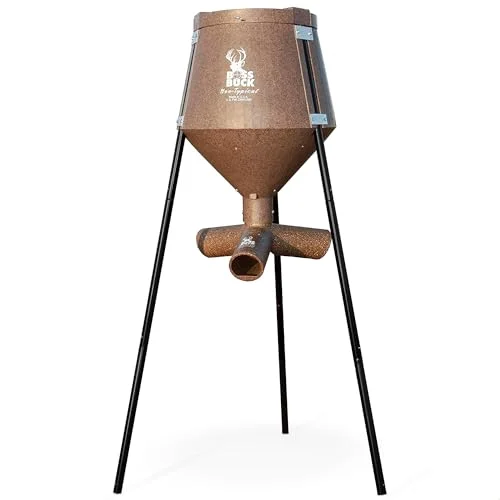
Best for: The biggest no-timer capacity on the tallest legs in this group.
- 200 lb hopper: the gravity class’s biggest capacity here — paired with the no-electronics feed mechanism, refills stretch toward a month.
- Three feed ports with adjustable flow: spread access around the tripod and tune how fast corn reaches the ground.
- 75-inch galvanized legs: steel that will not rot or rust through, holding the hopper at fill height with the ports well clear of wet ground.
- Gravity class, plainly: this listing is the gravity feeder — no timer or spinner kit is included, and none is assumed.
- Corn math: two hundred pounds is about a month of feed for a small herd, which makes this the autonomy-per-trip call of the gravity class.
Pros:
- 200 lb capacity on tall galvanized legs
- Adjustable-flow ports on all three sides
- Galvanized steel resists rot and rust
Cons:
- No timer or spinner in this kit
- Assembly is a two-person job at this height
- Gravity class means zero feed control
5. HECASA 450 lb Steel Gravity Deer Feeder
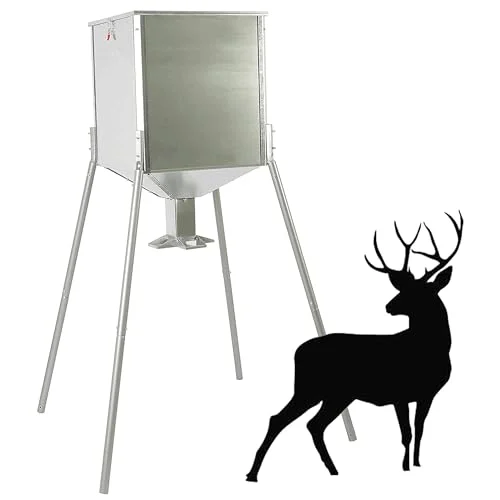
Best for: High-traffic ground where refill trips, not the ask, are the bottleneck.
- 450 lb steel hopper: the largest capacity of any feeder here — on heavy-traffic sites, refilling becomes a monthly chore instead of a weekly one.
- Zinc-plated steel body: metal construction that shrugs off weather and varmint teeth, built for sites where polymer drums eventually lose.
- 78-inch tripod: steel legs carry the loaded weight and hold the hopper at working height.
- 73 lb kit weight: plan the assembly and the site before the truck rolls — this is a two-person, bring-the-tools install.
- Foot kit excluded: the selected offer leaves ground anchoring out — anchor it separately or it walks.
Pros:
- 450 lb capacity — refills go monthly
- Zinc-plated steel for permanent sites
- Steel class at a mid-band ask
Cons:
- Foot kit excluded — anchor separately
- Heavy two-person assembly
- Small feedback base — vet the recent comments before ordering
6. ASF All Seasons Feeders EZ Deer Tree Protein Feeder
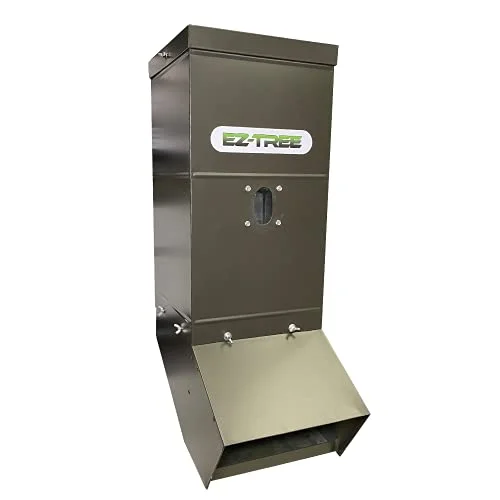
Best for: A grow program that needs protein-capable hardware, not a corn spinner.
- Protein-class hardware: runs pellets, corn, rice bran, and mineral — feed types a broadcast spinner jams on, which makes this the grow-program station.
- 85 lb hopper: sized to the protein cadence, where fresh feed matters as much as volume and stale pellets get refused.
- Tree- or post-mount: hangs on a trunk or post with the included straps — no tripod footprint and no ground anchoring.
- Powder-coated metal body: the finish takes weather and squirrel teeth without flaking.
Pros:
- Protein, mineral, and bran capable
- Trunk mount saves floor space
- Powder-coated weather finish
Cons:
- Small feedback base — read the recent comments first
- Mount point and straps are site-dependent
- 85 lb hopper refills more often than the bulk lanes
7. On Time 71540 Buckeye Gravity Feeder
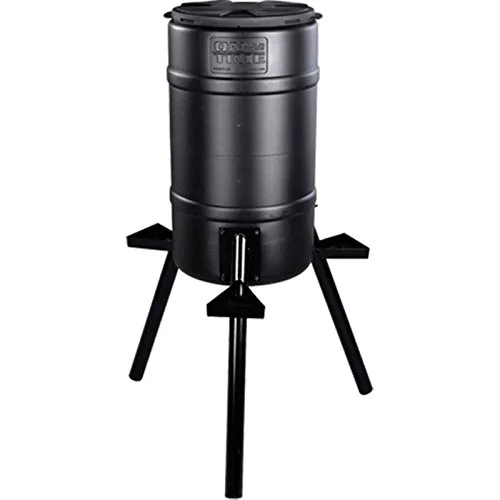
Best for: A proven barrel feeder that runs through seasons with nothing to charge.
- 30-gallon polyethylene drum: barrel geometry that sheds weather and resists the sun-cracking that eventually kills lesser polymer.
- No-electronics gravity feed: the timer maker’s own no-electronics entry — nothing to charge, program, or break in a cold snap.
- Capacity naming, cleared up: the maker’s catalog calls the Buckeye a 200 lb gravity feeder, while the Amazon page identifies the 30-gallon 71540 model — the numbers differ by source, so both are on the table rather than smoothed over.
- Set-and-forget cadence: with no schedule to manage, the only chore left is the refill walk.
Pros:
- Nothing to charge or program
- Weather-shedding drum geometry
- Veteran design with years of field history
Cons:
- Capacity naming differs between catalog and page
- No broadcast control by design
- Gravity access serves varmints too
Roll out the Buckeye on Amazon
Frequently Asked Questions
Q1: Are gravity feeders better than timed broadcast feeders?
A: They solve different problems. Gravity stations run forever on no power, feed on the animals’ schedule, and handle any dry feed — their cost is zero control and open access for raccoons and hogs. Broadcast units meter corn on your schedule, spread it wide for herd visibility, and pair with app scheduling — at the cost of batteries, mechanics, and jams. Managed properties often run both: gravity stations as the always-on backbone, one broadcast unit for the observation periods you actually want to shape.
Q2: How much capacity does a deer feeder really need?
A: Count the consumption, not the catalog. A small station feeding a handful of deer burns 5–10 pounds a day, which makes 30 gallons last a couple of weeks; the 200–300 pound class buys a month of autonomy; and the 400-plus steel lanes exist for high-traffic sites where a monthly refill is the whole point. The honest answer is capacity per trip — the biggest hopper your vehicle, your back, and your install plan can service without resentment is the right one.
Q3: Where should I place a deer feeder on my property?
A: 100-plus yards from your stand sites, on natural travel corridors between bedding and food, with clear approach lanes and no fence lines in the throw pattern. Keep stations away from roads and neighbor lines, give gravity tubes clearance on all sides, and face broadcast throw away from water. Placement trains movement — the feeder decides where the herd’s evening pattern forms, so put it where you want that pattern to live.
Q4: Do deer feeders attract hogs and raccoons?
A: Yes, and the gravity class especially — open tubes serve everything that can reach them. Broadcast timers help by throwing only at dawn and dusk windows, and spinners mounted high on tall tripods exclude the low raccoons but not the hogs. Serious varmint defense is a site decision: pen designs, suspended protein stations, and trap programs all cost less than a season of spilled corn. Budget the varmint plan when you budget the feeder.
Q5: What maintenance does a deer feeder need through the season?
A: Gravity stations need almost none — check tubes after storms, keep the hopper sealed, and watch for varmint damage. Broadcast units add battery charging or solar input, spinner inspection after wet feeds, and a schedule audit when the season shifts. Steel lanes want an annual rust check at the welds and hardware. Every class benefits from a full-empty clean-out between seasons, because old, moldy feed is the one thing that turns a feeding station into a liability.
Final Verdict
If you want the best deer feeder that stands durable, feeds honest and saves trips, don’t overthink it—these are already:
✔ Capacities, mounts, ports, and power come from each maker’s own hardware, with exclusions named where they change the install.
✔ Every card sticks to spec — what the feeder does and what it leaves out, not the marketing around it.
✔ Broadcast control, gravity autonomy, and protein capability each get a station, sorted by the chore it saves.
Best Overall – Moultrie 250 Lb Pro Hunter III Tripod Feeder
Best Value – American Hunter 30-Gallon Nesting Hopper Gravity Feeder (AH-225GRAV)
Best Premium – Banks Outdoors Feedbank 300
Best Gravity Capacity – Boss Buck 200 lb Gravity Deer Feeder
