
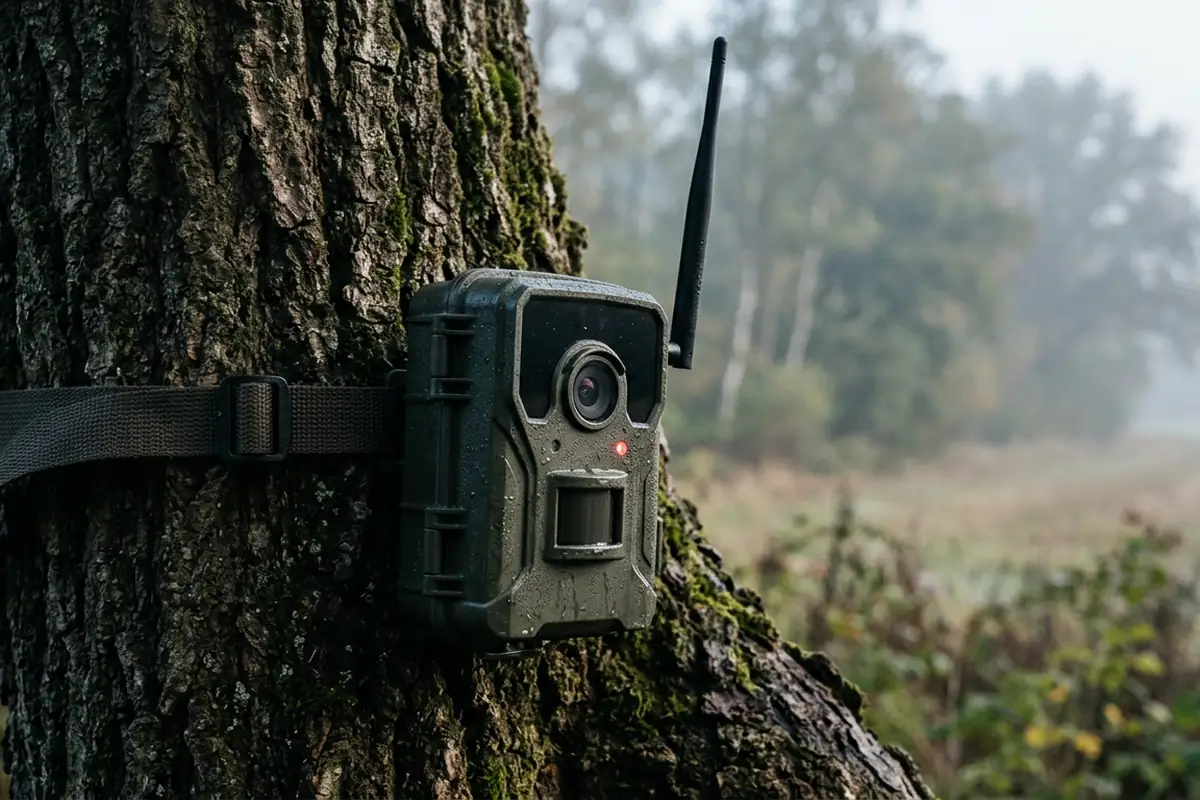
Managing more than one property turns scouting into a logistics problem. You cannot be at three farms on the same Saturday, and the two weeks a mature buck patterns his daylight movement are exactly the two weeks you have work. The best cellular trail camera closes that gap by putting the evidence on your phone rather than on a card you have to drive out and collect.
What separates a cellular camera from a good camera is not the picture quality. It is the deal you make with the network: the camera gets a cell radio and a data plan, and in exchange you accept that every image depends on the bars at that tree, the carrier that serves that valley, and the plan terms you agreed to in September. A camera with twenty megapixels and one bar will lose to a camera with eight megapixels and three bars every single time.
The plans are where most buyers get surprised. Some cameras ship with a pre-installed SIM and a trial, some charge monthly for photo delivery, and one here advertises a free photo plan. Read the plan before the megapixels, because over a season the subscription can exceed what you paid for the camera. A modest camera on a punishing plan is not a modest purchase.
Running several properties adds a second layer: you need to know which camera is where. GPS on the unit, a locator in the app and a shared login for a lease partner all earn their keep when you are juggling four farms and a borrowed truck. This list is built around that life, not around a single camera on a single scrape.
Quick Picks
Best Overall: Tactacam Reveal X 3.0 — dual-carrier LTE with 8GB onboard and GPS
👉 Deploy the Tactacam Reveal X on Amazon
Best Live View: GardePro X66 Pro — 0.1s trigger and live requests on demand
👉 Peek through the GardePro X66 Pro on Amazon
Best for Rotating Coverage: Dual-Lens Solar PTZ 2-Pack — 350° pan on two cameras
👉 Pan the Dual-Lens PTZ Twin Pack on Amazon
Best for Feeders and Gates: Moultrie Edge 3 — AI buck detection with feeder control
👉 Anchor the Moultrie Edge 3 on Amazon
Comparison Table
| Product Name | Best For | Price Range | Check Price on Amazon |
|---|---|---|---|
| Tactacam Reveal X 3.0 Cellular Trail Camera | One camera that just reports | Mid | See the Tactacam Reveal X |
| Dual-Lens Solar PTZ Cellular Camera 2-Pack | Covering ground from one tree | Premium | Open the Dual-Lens PTZ Pair |
| GardePro X66 Pro Cellular Trail Camera | Live view without walking out | Budget | Compare the GardePro X66 Pro |
| SPYPOINT Flex-M Twin Cellular Camera | Free plan while you learn the ground | Mid | Review the SPYPOINT Flex-M Twin |
| Moultrie Edge 3 Cellular Trail Camera | Food plots and feeder control | Mid | Read the Moultrie Edge 3 |
| SEHMUA 4K Cellular Trail Camera | Long stretches without a battery swap | Mid | Study the SEHMUA Solar Camera |
| VOOPEAK 4G LTE Cellular Trail Camera 2-Pack | Two properties on one order | Mid | Find the VOOPEAK LTE Pair |
| Moultrie Edge 4 Solar Cellular Camera | A plot with no battery routine | Premium | View the Moultrie Edge 4 Solar |
| 360° View Cellular LTE Trail Camera | Watching a junction or gate | Mid | Check the 360° LTE Camera |
Buyer’s Guide
1. Check the Bars Before the Spec Sheet
No cellular camera outruns a dead zone, and a tower map will not tell you what a valley does to a signal. Walk the ground with the phone you will actually use, stand where the camera will hang, and note the bars at each spot. Multi-carrier units that auto-select a network give you a wider margin than a single-carrier camera, which is why several entries here advertise four-carrier or dual-SIM switching. If half your spots are dead, buy fewer cameras and put them where the signal lives.
2. Read the Plan, Not the Price Tag
Cellular cameras are sold at one price and run on another. Some ship with a pre-installed SIM and a short trial, some require a monthly photo plan, and one here carries a free photo plan as its headline. Work out a full season of service before you compare units, because a low purchase number with a high subscription inverts the whole calculation. Check whether live view and HD requests are included, since those are often billed differently from standard photo transmission.
3. Match Power to Your Visit Interval
Battery life is a function of how far away you live. A camera running AA cells is fine when you pass it weekly; on a property you see monthly, solar is what keeps it alive. Several cameras here pair a solar panel with a rechargeable pack, and the Edge 4 integrates the panel into the body. Cold drains a lithium pack faster than a mild week, and a camera that transmits every motion event empties itself quicker than one on a schedule, so set the sensitivity realistically.
4. Decide How Many Properties, Then How Many Cameras
Two properties with two cameras each beat one property with four. The twin packs here are built for that math, and the dual-lens PTZ covers more ground from a single tree by panning rather than by adding hardware. Before buying, sketch the layout: a camera on the approach, one on the food source, and one on the gate is a working network. Anything beyond that is a camera you will forget to check.
One Mistake to Avoid: Buying One Camera for Four Properties
The mistake is buying one high-end camera and moving it between farms all season. Every move resets the intel, costs you a sit, and leaves the other properties blind for weeks at a time. It is a fast way to collect a lot of photographs of one corner of one farm. Buy the number of cameras that matches the number of places you need eyes, even if each unit is modest, and leave them in place long enough to build a pattern.
Best Cellular Trail Camera: 9 Remote-Monitoring Options for Hunters Managing Multiple Properties
Nine cellular cameras built for hunters who cannot be everywhere, from an integrated-SIM unit with onboard storage to a dual-lens PTZ pair that pans 350 degrees from one tree. Each entry gives the resolution the page states, the trigger and detection figures, the power arrangement, the carrier and plan situation and the app it runs on, then names where the camera falls short. Where the page hides the numbers, that gap is said out loud rather than filled in.
1. Tactacam Reveal X 3.0 Cellular Trail Camera
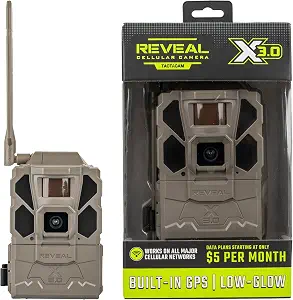
Best for: A hunter who wants a camera that reports without a card pull and without a carrier decision.
- Auto-Connect LTE: an integrated SIM that locks onto AT&T or Verizon, whichever is stronger on site.
- 4K Photo and 1080p Video: the resolution pair named in the product title.
- 8GB Internal, No SD Card: onboard storage with GPS for locating the unit in the app.
- 6+ Month Battery Life: with a low-glow flash that throws 96 feet.
- IP66 Housing: sealed against weather on a body that mounts with a strap.
Pros:
- Automatic carrier switching removes the biggest guesswork on unfamiliar ground.
- Onboard memory means no card to buy, format or lose between properties.
- GPS puts every camera on a map in the app, which matters at four farms.
Cons:
- A data plan is required and the plan terms are not detailed in the product bullets.
- Six months of runtime is a manufacturer figure that depends on photo volume and cold.
- No published trigger figure, so the response time cannot be compared directly.
Bring the Tactacam Reveal X online on Amazon
2. Dual-Lens Solar PTZ Cellular Trail Camera 2-Pack
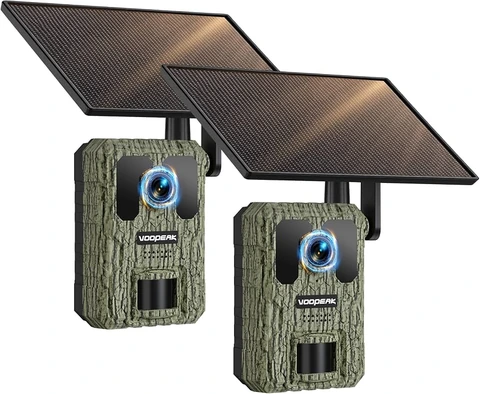
Best for: A property line you want to sweep rather than sample, with two units in the box.
- Dual Lenses Per Camera: a fixed lens for one area plus a PTZ lens that pans 350° and tilts 90°.
- 2K Recording: triggered by PIR detection that senses movement up to 33 ft away.
- 5W Solar Plus 7800mAh: a panel and a rechargeable pack in each camera.
- 2 Cameras Per Pack: doubling the ground covered on one order.
- 256GB microSD Support: local storage with optional cloud backup, in an IP65 shell.
Pros:
- Panning a PTZ head covers angles that would otherwise need a second camera.
- A 2-pack with solar on both units is the widest coverage per order here.
- Live view and motion alerts run without Wi-Fi, which suits remote acreage.
Cons:
- A 33 ft detection range is the shortest here and suits close trails only.
- Solar output depends on canopy, so a shaded tree may not keep up.
- The card is not included and cloud storage is an extra decision.
Sweep the Dual-Lens PTZ Twin Pack on Amazon
3. GardePro X66 Pro Cellular Trail Camera
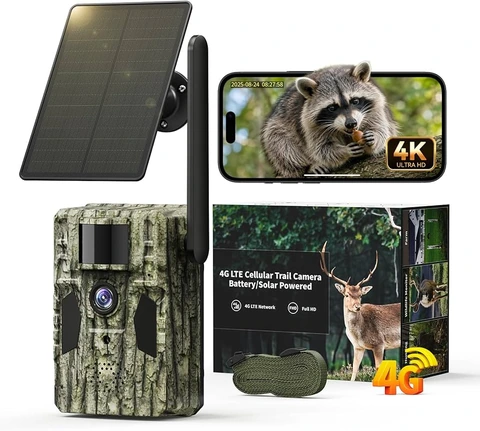
Best for: A hunter who wants to look at a spot right now rather than wait for the next trigger.
- 0.1s Trigger: with a three-PIR sensor system and a 120° detection angle.
- 7800mAh Battery Pack: rechargeable and replaceable instead of AA cells.
- 1296p HD Video: recorded with sound and previewed in the GardePro app.
- 940nm No-Glow Flash: infrared that will not visibly flare at a bedding area.
- Built-In GPS: location syncs on a schedule and can be requested on demand.
Pros:
- The fastest trigger in this group at a tenth of a second.
- A rechargeable pack ends the routine of buying AA cells by the case.
- No-glow infrared keeps a camera discreet on a property you rarely visit.
Cons:
- An active data plan is required for uploads, live view and HD requests.
- The product bullets name the plan as necessary without stating its tiers.
- Video previews are capped at 3 to 300 seconds unless you request the full clip.
Request footage from the GardePro X66 Pro on Amazon
4. SPYPOINT Flex-M Twin Cellular Trail Camera
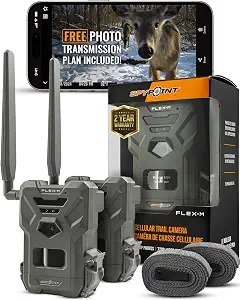
Best for: Getting two cellular cameras running on a property without a monthly commitment at the start.
- 32MP Photos and 1080p Video: video recorded with sound.
- Dual-SIM Coverage: 2 SIMs picking the strongest of the major carriers automatically.
- Free Photo Plan: included per the product title, with the app at no charge.
- 2 Cameras Per Pack: both managed from 1 SPYPOINT account on the free tier.
- 4 Capture Modes: photo, video, time-lapse and time-lapse-plus on each unit.
Pros:
- A free photo plan takes the sting out of the first season’s subscription.
- Dual-SIM switching gives a second network to fall back on in weak cover.
- Four capture modes make the same camera useful for a scrape and a gate.
Cons:
- The plan that follows the free tier is not described in the product details.
- A 32MP figure is the headline here while the video tops out at 1080p.
- Few spec bullets are published, so trigger and range figures need the manual.
Start free on the SPYPOINT Twin on Amazon
5. Moultrie Edge 3 Cellular Trail Camera
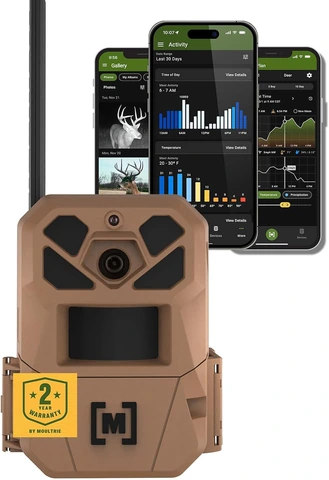
Best for: A food plot you cannot visit weekly and a feeder you would rather not walk up to.
- 40MP Photos and 1080p Video: with a 15-second clip length on a low-glow infrared flash.
- 0.5 Second Trigger: paired with a 100 ft detection range.
- 4-Carrier Auto-Connect: four major networks selected automatically, with no SIM card.
- AI Buck Detection: sorts deer from the rest and sends an instant alert.
- Live Aim and GPS: a live view for aiming plus mapping for all 2 camera slots.
Pros:
- Feeder control from the app saves a trip just to check a spinner.
- AI detection cuts the false alerts that make a busy camera easy to ignore.
- Four-carrier switching is the widest network spread on this list.
Cons:
- Feeder control only works with compatible feeders, not any brand.
- Half a second is slower than the no-glow camera above it on this list.
- The unit is a single camera, so covering two spots means buying twice.
Point the Moultrie Edge 3 at the plot on Amazon
6. SEHMUA 4K Cellular Trail Camera
Best for: A far property where you want to skip the battery routine for a season.
- 74MP Photos and 4K Video: the resolution carried in the product title.
- 0.1s Trigger: with a 120° lens and detection out to 65 ft.
- 4W Solar Panel: sized to keep a camera running through long sunny stretches.
- Built-In SIM: pre-installed and compatible with the major US carriers.
- 7-Day Data Trial: included so the camera works out of the box.
Pros:
- Solar plus a trial SIM makes this the quickest camera here to get live.
- A 65 ft detection range sits in the middle of this group comfortably.
- 4K video is the highest video resolution on the list.
Cons:
- The trial is seven days, and what follows it is not stated on the product page.
- 74MP is an interpolated figure; the sensor itself is not described.
- One owner report set is still thin for a season-long judgement.
Go live with the SEHMUA Solar Camera on Amazon
7. VOOPEAK 4G LTE Cellular Trail Camera 2-Pack
Best for: Two properties that both need eyes and neither of which you visit often.
- 2 Cameras Per Pack: each with its own solar panel in the box.
- 2K HD Video: with AI species recognition on captured footage and a 2-pack layout.
- Built-In SIM: pre-installed for 4G LTE without a Wi-Fi network.
- Remote Access: full management of both cameras through 1 companion app.
- No Wi-Fi Required: designed for ground with no internet at all.
Pros:
- Two solar units in one order put two properties on camera in a single move.
- Species recognition cuts the images of wind and passing trucks.
- Built-in SIM means no shopping for a card before the first setup.
Cons:
- The plan behind the built-in SIM is not published on the product page.
- AI species recognition is a claim, and the page does not state its accuracy.
- No owner score is displayed, so there is no track record to weigh yet.
Cover both farms with the VOOPEAK Pair on Amazon
8. Moultrie Edge 4 Solar Cellular Trail Camera
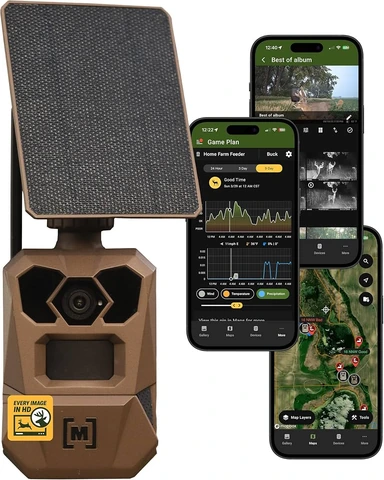
Best for: A plot you want running all season without a battery routine.
- Integrated Solar Panel: built into the body rather than bolted on, 1 piece to mount.
- 40MP Photos and 1080p Video: scout footage through the Moultrie app.
- Removable Li-ion Battery: swappable when the pack eventually ages.
- Multi-Carrier Cellular: automatic selection across 4 major networks.
- Night Vision: low-light capture for the 2 hours around dawn and dusk.
Pros:
- An integrated panel means nothing to forget, lose or aim separately.
- A removable lithium pack can be replaced instead of retiring the camera.
- Same app and ecosystem as the Edge 3, so a mixed fleet is easy to manage.
Cons:
- The product page publishes no trigger or detection figures at all.
- A fixed panel cannot be tilted if the mounting tree shades it.
- One unit left at the time of checking, so availability is tight.
Set and forget the Moultrie Edge 4 on Amazon
9. 360° View Cellular LTE Trail Camera
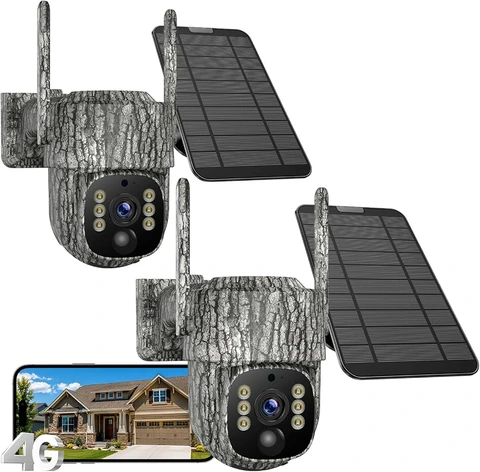
Best for: A junction, gate or camp where you want one camera to watch every approach.
- 360° View: a single unit covering all approaches rather than one window.
- 2.5K Live Feed: streamed to your phone over the cellular network.
- Human Auto Tracking: the camera follows movement rather than filming an empty lane.
- Built-In SIM: 4G LTE on a pre-installed card.
- Solar Panel and Dual Night Vision: 2 illumination sources for after dark.
Pros:
- A 360-degree view solves a junction that would take three fixed cameras.
- Human tracking turns a detection into a usable clip of the subject.
- Two-way audio adds a way to check in or discourage a visitor remotely.
Cons:
- No owner score or count is published on the product page.
- Almost no specification bullets, so trigger speed is an unknown.
- Wide coverage trades detail, and a distant deer will be small in frame.
Watch the junction with the 360° Camera on Amazon
Frequently Asked Questions
Q1: What makes the best cellular trail camera different from a standard one?
A: It has a cell radio and a SIM, so it pushes photos to your phone instead of writing only to a card. That removes the walk out, which is the whole point when a property is hours away or you run several. The trade is dependence: every image needs signal at the tree and an active data plan. A standard camera needs neither, but it also cannot tell you anything until you drive out and pull the card.
Q2: Do I need a data plan for every cellular trail camera?
A: Yes, with variations in how the plan is sold. Some cameras ship with a pre-installed SIM and a short trial before a monthly charge begins, some bundle a free photo plan at the entry tier, and some require you to choose a plan before the camera will upload at all. The SPYPOINT Flex-M Twin advertises a free photo plan, and the SEHMUA includes a seven-day trial. Work out a full season of service before comparing units, because the subscription outlasts the purchase.
Q3: Will a cellular trail camera work on property with weak signal?
A: Sometimes, and the camera matters less than the tree. A multi-carrier unit that auto-selects the strongest network will hold a usable signal where a single-carrier camera drops out. Tactacam, Moultrie and SPYPOINT all advertise some form of automatic carrier selection. Test the actual spot with your phone before committing, and remember that summer foliage and a wet canopy both weaken the signal against what a winter test shows.
Q4: How long do batteries last in a cellular trail camera?
A: Between a few weeks and most of a season, depending on how far the photos travel and how often the camera fires. Tactacam quotes six months or better on its lithium cartridge, and the solar units here are designed to run continuously with enough sun. Sensitivity settings, photo volume, cold nights and weak signal all shorten the run, because a camera searching for a tower burns power faster than one with a strong connection.
Q5: Can several people share one cellular trail camera account?
A: On most of these platforms yes, and it deserves confirming before a lease season starts. Moultrie, SPYPOINT and GardePro all describe app-based management, and sharing is normally done through the app rather than by passing a login around. Sharing matters on a multi-property lease where partners split the outlay. Check the plan tier too, since some subscriptions limit how many cameras or users one account can carry.
Final Verdict
If you want the best cellular trail camera that keeps reporting while you are on another farm, don’t overthink it—these are already:
✔ Carrier switching described plainly, not hidden behind a logo
✔ Plan terms named as required rather than discovered after purchase
✔ Power and detection figures quoted where the page publishes them
Best Overall – Tactacam Reveal X 3.0 Cellular Trail Camera
Best Live View – GardePro X66 Pro Cellular Trail Camera
Best for Rotating Coverage – Dual-Lens Solar PTZ Cellular Trail Camera 2-Pack
Best for Feeders and Gates – Moultrie Edge 3 Cellular Trail Camera
