Deer smell far better than you do, and they use that sense to decide whether a place is safe. A hunter who has walked in, sat down and been winded by the first doe that crosses downwind rarely knows it happened. The deer just leaves, and the hunter assumes there were no deer. Learning how to control scent when deer hunting is mostly a matter of doing a few things in the right order, every trip, until they are habit.
This guide follows that order: the wind first, then the night before, the morning of, the walk in and the hours in the stand. It ends with the few products worth buying and the many a first-season hunter can leave on the shelf.
Why scent is the thing that most often spoils a beginner’s hunt
Most beginner mistakes with sound and movement are easy to see. You hear the branch snap, or you catch yourself fidgeting. Scent gives no feedback. You cannot smell yourself, and a deer that catches your odor from 100 yards away leaves without making a sound.
That is why scent problems get blamed on bad luck, poor stand placement or a slow morning. Often the stand was fine and the deer simply smelled you on the way in, or when the breeze shifted an hour after sunrise.
Human odor comes from several sources, and each one needs a different fix:
- Sweat and body odor, which grow worse when you overheat on the walk in.
- Dirty or stale clothing, including detergent perfumes, smoke, food and fuel smells.
- Boots and gloves, which leave a scent trail along the ground.
- Breath, hair and skin products.
You will not remove all of it. The aim is to reduce what you give off and, more importantly, to keep what remains from blowing toward the deer.
How to control scent when deer hunting
A repeatable routine has five parts, in this order:
- Pick the stand and the day by wind direction.
- Wash, dry and store your clothes the night before.
- Shower and dress in a way that keeps the scent from returning.
- Walk in slowly, with your hunting clothes kept clean until the last stretch.
- Sit in the stand with habits that keep your scent contained.
Every step after the first only lowers your odor. The first step decides where that odor goes. Treat the rest as a checklist you run through the same way each trip, so nothing depends on remembering it in the dark at 4 a.m.
Start with the wind, because no product beats it
A deer’s nose works on air that reaches it. If the breeze carries your scent away from where deer will be, a washed jacket matters little. If it carries your scent straight into their path, no spray will hide you.
The rule is simple: you want the wind blowing from the deer toward you, or across the deer’s path, never from you toward them. Before you pick a stand for the day, check the forecast for wind direction and speed, and plan the stand and the walk in around it. Keep your approach route in mind too, because walking in with the wind at your back can push your scent across the whole area you plan to hunt.
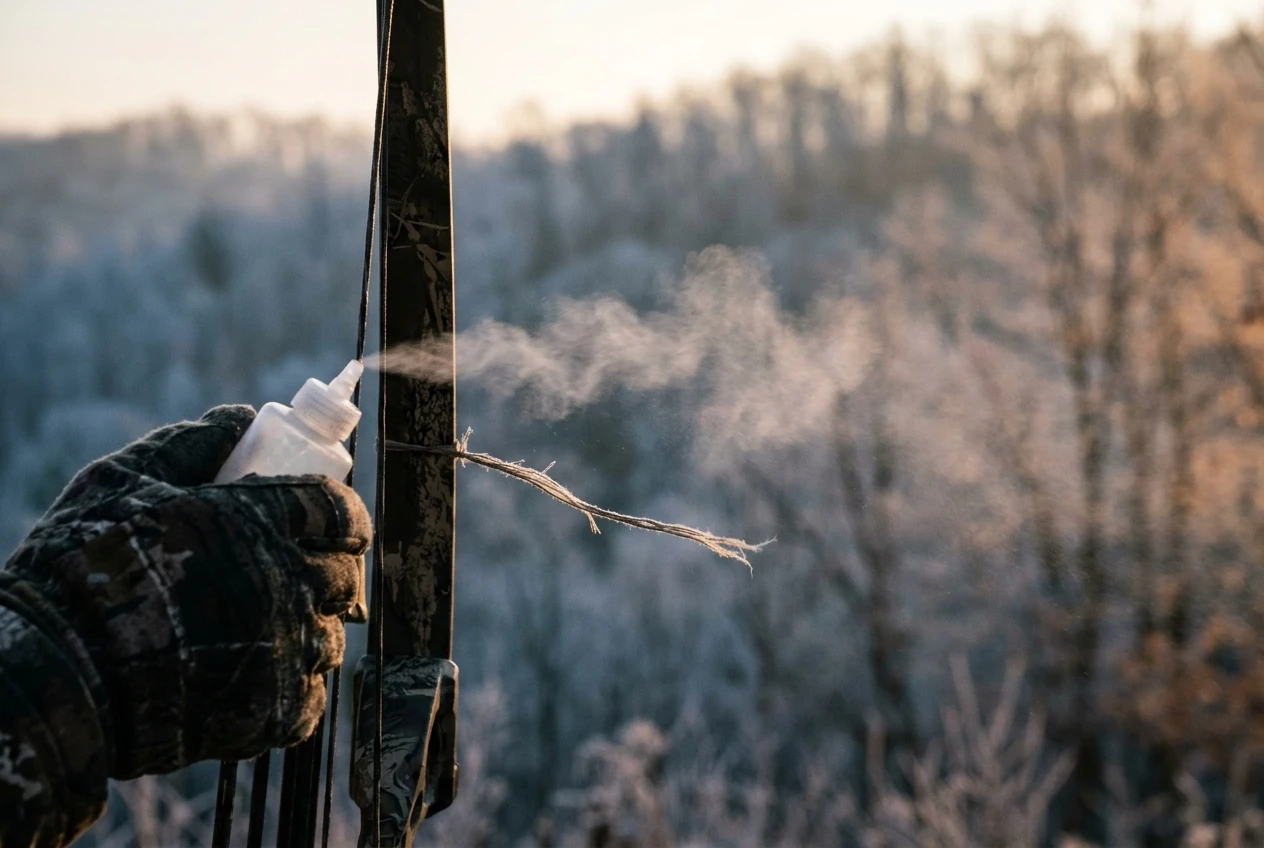
On the ground, a small squeeze bottle of wind-checking powder shows you what the air is actually doing. A light thread or feather tied to your bow or pack does the same job for almost nothing. Check it at the trailhead, again on the walk in and again once you are in the stand, because wind can shift.
In hilly ground, air also tends to rise along slopes as the morning warms and to sink as the evening cools. That can carry your scent uphill in the morning and downhill in the evening, even when the forecast wind looks steady. Pay attention to how the powder moves where you actually sit.
If you have more than one stand location, the practical approach is to match each one to a wind direction and hunt it only when the wind suits it. Our guide on where to place a tree stand for deer hunting covers how to choose those spots and set them up with the wind in mind. On a day when the wind is wrong for every stand you have, staying home is a legitimate choice. A bad-wind sit tends to teach nearby deer to avoid the spot.
The night before: washing, drying and storing your hunting clothes
This is where you get the most effect for the least money. Clothes that smell like your house, your dryer sheets or last week’s dinner carry that smell into the woods.
Wash your hunting clothes in an unscented detergent made for the purpose, or a plain fragrance-free one. Ordinary detergents often contain perfumes and brighteners, and those can be the most unnatural thing a deer smells all week. Skip fabric softener and dryer sheets entirely.
Dry the clothes on a line outdoors if the weather allows. If it does not, use the dryer on a setting without scented sheets, and run it empty first if it is full of the smell of past loads. Let the clothes air out before you pack them.
Then store them so they stay clean:
- Seal them in a large plastic tote with a lid, or a clean trash bag, and keep that container away from the kitchen, the garage and the pets.
- Add a handful of natural material from the area you hunt, such as cedar or pine, if you like. It is optional and cheap.
- Pack your boots, gloves and hat separately in a clean bag.
Pack your bag the night before as well. Rushing in the morning leads to shortcuts, and shortcuts are how a pack full of clean gear ends up smelling like breakfast.
Morning of the hunt: what to do at home and what to leave until you reach the trailhead
At home, shower with an unscented soap and shampoo. Brush your teeth, and use unscented deodorant if you use any. Avoid strong-smelling breakfasts such as bacon, onions or heavy coffee if you can, since smell leaves the body through breath and skin.
Do not put on your hunting clothes at home. Dress in ordinary clothes for the drive, and carry the sealed tote with you. The car, your kitchen and the gas station all hold odors that cling to fabric.
At the trailhead, change into your hunting clothes away from the vehicle exhaust and fuel smells. Put your boots on last. Many hunters wear a pair of old shoes for the drive and keep their hunting boots in a bag until they step onto the trail.
Other points that belong at the trailhead rather than at home:
- Fill the gas tank the day before, so you are not handling fuel in your hunting gloves.
- Do not smoke or vape once you are dressed.
- Check the wind with your powder or thread before you start walking.
If you use a scent-eliminating spray, apply it here, once the clothes are on and the wind is checked. That is also the time to use any scent-free wipes on your hands and face.
The walk in: keeping sweat and boot scent down on the way to your stand
Sweat is one of the largest scent sources you control, and the walk in is where you generate most of it. A hunter who hikes briskly in full layers arrives soaked and sits in the stand with a cooling, strongly smelling base layer.
Dress for the walk with fewer layers than you will need on stand. Carry the heavier jacket in your pack and put it on once you arrive. Moving slowly keeps your body temperature down and keeps you quieter too. Leave earlier than you think necessary so you are never hurrying.
Rubber-soled boots made for hunting are one product that earns its place, because rubber holds less odor than leather and does not soak up ground scent as readily. Walk the route that keeps you downwind of where deer bed and feed, and avoid brushing against every branch and bush, since each touch leaves scent on the plant at deer height.
Do not walk the same trail through a field edge or across a deer path when you can avoid it. Skirting those areas puts less scent where deer will cross it later. If you scouted the property ahead of time, plan this route then. Our guide to finding public land to hunt deer explains how to scout an area before opening day, which is when you should pick your approach path.
In the stand: scent habits that matter once you are sitting still
Once you stop moving, your body starts to cool and your scent changes. This is the time to put on your outer layer and settle, rather than keep adjusting.
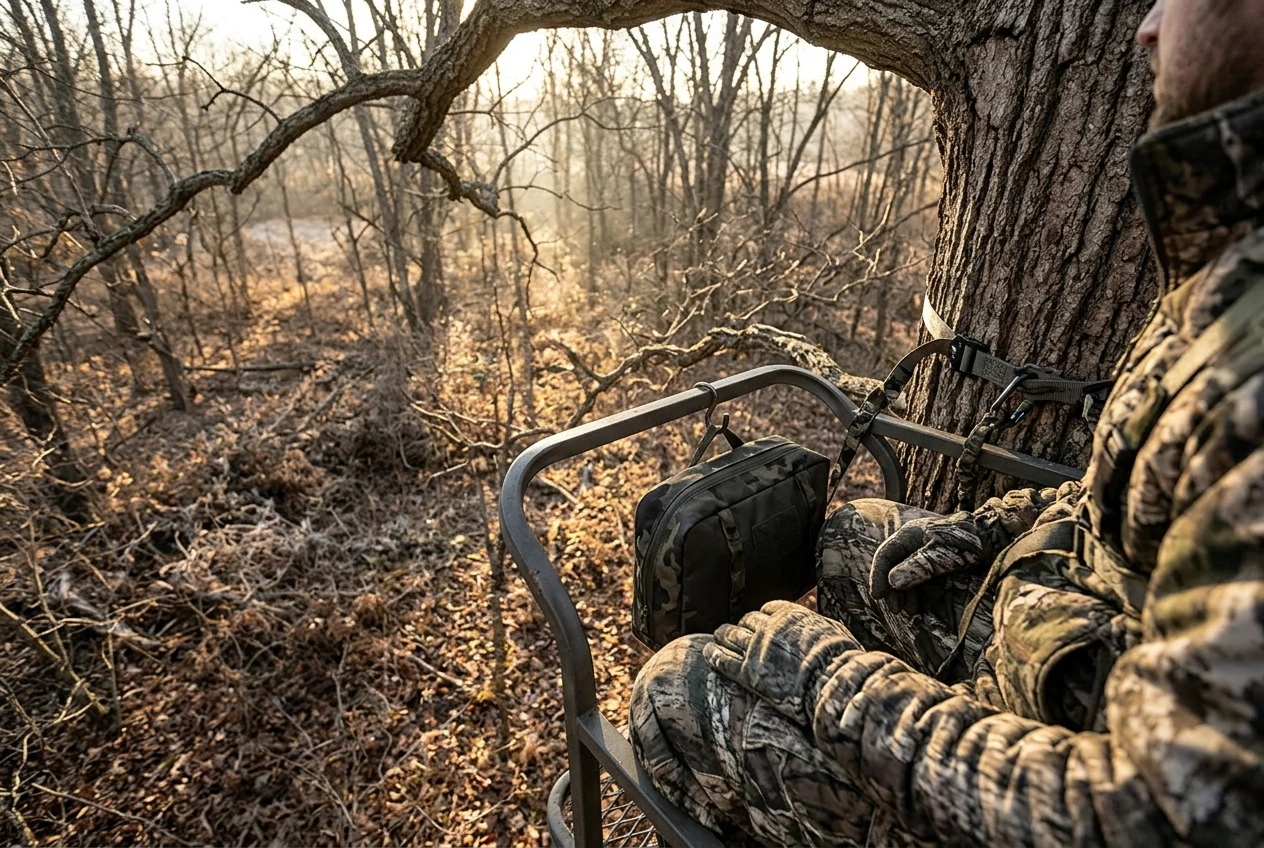
A few habits help:
- Keep your pack and spare gear in a sealed bag hung from the stand rather than loose beside you.
- Avoid eating strong-smelling snacks. Plain, low-odor food is better, and wrappers should go back in the bag.
- Keep your hands in gloves, and avoid touching your face and hair.
- Check the wind regularly. If it swings so your scent will blow toward the area where deer are likely to approach, you have two choices: stay still and accept the risk, or climb down quietly and leave.
Sit higher where you can. Height does not erase scent, but it lets the breeze carry your odor over a deer’s head rather than straight into its nose at ground level, especially in steady wind.
When you leave, walk out by a route that does not cross where deer will arrive that evening. Hunters often wreck an evening sit by walking out through the field a doe is about to enter.
Scent products worth buying first, and what a beginner can safely skip
No scent product makes you undetectable. At best, each one reduces odor a little. Spend in this order.
Worth buying first
- Unscented laundry detergent made for hunting clothes, or a fragrance-free one from the regular shop.
- A sealable tote or large bag for storing clean clothes.
- A wind checker, either a powder bottle or a piece of thread you already own.
- Rubber hunting boots, if your budget allows. Your boots are a major source of ground scent.
- Unscented body soap and shampoo for the morning shower.
Optional, once the basics are in place
- Scent-eliminating spray, for a light finish at the trailhead.
- Scent-free wipes for hands and face.
- A carbon-lined base layer. Some hunters like these, but the evidence that they change results for a beginner is thin, so it can wait.
Safe to skip in your first season
- Full scent-control clothing systems. They cost a lot, and washed ordinary hunting clothes get you most of the benefit.
- Ozone machines and similar devices, which are expensive and unnecessary at this stage.
- Cover scents and urine-based lures. Check your state’s rules before you consider them, because some states restrict natural deer urine products because of disease concerns.
If you are weighing what to spend on, a plain routine done the same way every trip will serve you better than a pile of products used inconsistently.
Frequently Asked Questions
Do I really need scent-free clothing to hunt deer?
You need clean clothing that does not smell of perfume, smoke or food. That does not require a special brand. Wash in unscented detergent, dry without softener and store in a sealed container, and your clothes will be in good shape.
What matters more, wind direction or scent control products?
Wind direction. Products reduce how much odor you give off, but the wind decides where it travels. A hunter downwind of the deer, with no products at all, is more exposed than a hunter upwind who has used every spray available.
Should I shower the morning of a hunt?
A shower with unscented soap helps, as long as you do not then dress in scented clothes or sit in a smoky car. Showering the night before and again in the morning is a common routine, and skipping it is not a disaster if the wind is right.
Do scent-eliminating sprays work?
They reduce some odor, and many hunters use them as a final touch. They do not hide a hunter in the wrong wind. Treat them as optional, and buy them after the detergent, tote and wind checker.
How do I keep my scent down if I get hot walking to the stand?
Walk slowly, wear fewer layers on the way in, and carry your heavier jacket to put on once you arrive. Starting earlier makes this easy, since you are not rushed.
Is it worth hunting on a day when the wind is wrong for my stand?
Usually not. If the wind carries your scent toward where deer travel, you may educate the deer and spoil the spot for later hunts. Choose a different stand, or wait for a better day.
Ready to fill in the rest of your kit? Read the beginner gear list to see which scent items earn a place in your pack and which can wait until next season.