
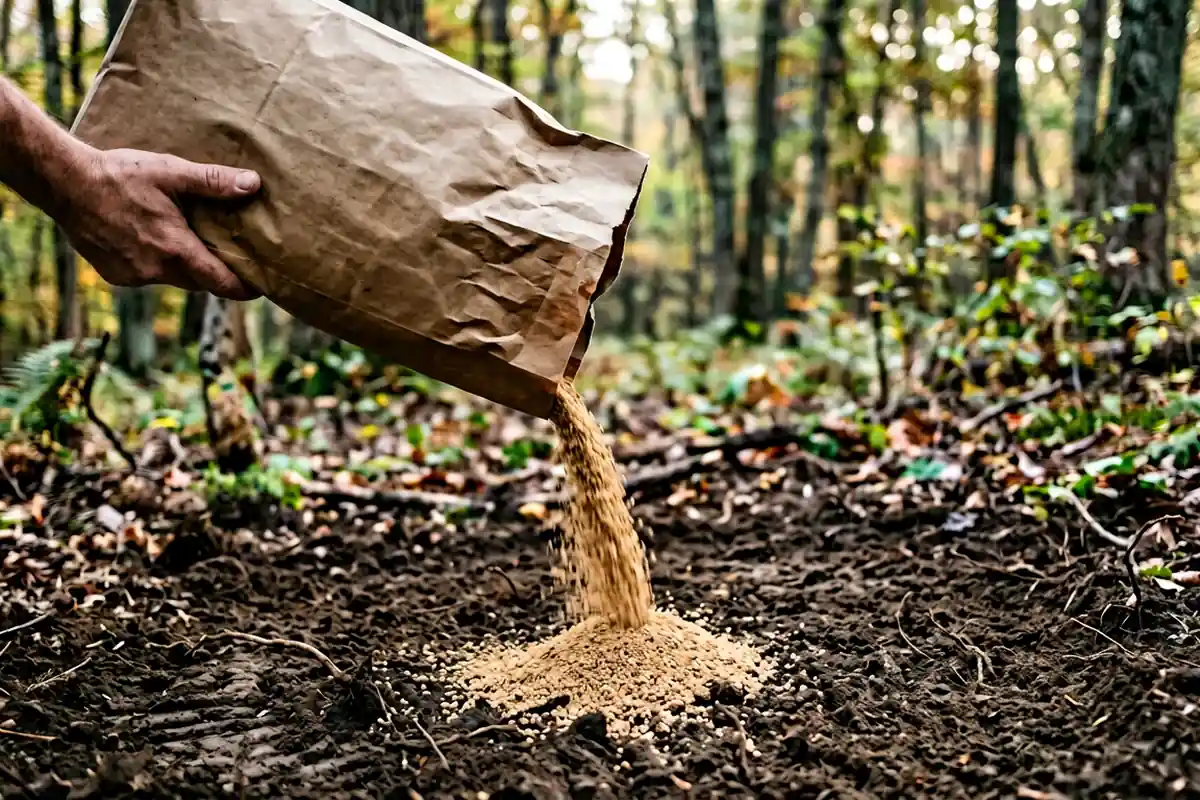
A deer mineral supplement is one of the few habitat inputs a landowner can put out without equipment, a soil test or a tractor, and that is exactly why the category is so poorly served. Bags advertise bigger antlers, better body weights and a healthier herd, and the label rarely tells you what is actually in the bag, how much ground it covers, or how often it has to be replaced.
What a mineral site actually does is straightforward. Deer seek sodium and other minerals they cannot get in quantity from browse, and they return to a site that supplies them. That traffic pattern is the real asset: a mineral lick becomes a scouting point, a camera station and a place where you can watch does and fawns through the summer. The antler claims on the bag are the manufacturer’s language, and no independent body verifies them.
The formats are where buyers of the best deer mineral supplement get caught out. A 6.5 lb powder goes into the topsoil at a prepared site, a 20 lb granule bag gets raked in, a 20 lb block sits on the ground, and a 12 lb natural rock is dropped where it lands. Each one has a different repeat interval and a different level of effort. Match the format to how often you visit the property before you compare anything on the label.
One legal point matters more than any bag claim for a deer mineral supplement: in several states a mineral site counts as bait, and baiting rules differ between the hunting season and the off-season. Check your state’s regulation before you establish a site on ground you intend to hunt over. A good mineral program and a violation are separated by one line in the rulebook.
Quick Picks
Best Overall: Whitetail Institute 30-06 — 20 lb with a 10 percent protein boost
👉 Top dress with the Whitetail Institute 30-06 on Amazon
Best Natural Rock: Trophy Rock by Redmond — a mined 12 lb lick, nothing to mix
👉 Place a Trophy Rock on Amazon
Best Powder: Evolved Habitats Deer Cane — 6.5 lb that works into the soil
👉 Powder a Deer Cane site on Amazon
Best Feed Block: Big Tine Fortified Deer Block — 13 percent protein, 5 percent fat, 10 percent fiber
👉 Position a Big Tine Block on Amazon
Comparison Table
| Product Name | Best For | Price Range | Check Price on Amazon |
|---|---|---|---|
| Whitetail Institute 30-06 Mineral and Vitamin | Ground sites in spring and summer | Mid | See the Whitetail Institute 30-06 |
| Trophy Rock by Redmond All Natural Lick | A permanent lick with no mixing | Budget | Open the Trophy Rock |
| Evolved Habitats Deer Cane Powder Mix | A fast mineral site that soaks in | Budget | Compare the Deer Cane Mix |
| Antler King Trophy Deer Mineral | Chelated minerals in a 20 lb bag | Mid | Review the Antler King Trophy |
| Ani-Logics Mineral Dirt 180 | Rain-resistant granules | Mid | Read the Ani-Logics Dirt 180 |
| Domain Outdoor Recharge Deer Mineral | A berry-scented 10 lb bag | Mid | Study the Domain Recharge |
| Big Tine Fortified Deer Block | Attraction and feed in one block | Mid | Check the Big Tine Block |
Buyer’s Guide
1. Know What Your Soil Already Has
A mineral bag tops up what the ground is short of, and most landowners have no idea which minerals those are. A soil test tells you pH and base saturation, and it costs less than two bags of anything on this list. Acidic ground holds minerals poorly, which is why several products here are formulated to be worked into the topsoil rather than scattered. Test first, then buy the amendment the ground is missing rather than the one with the loudest bag.
2. Match the Format to Your Visit Schedule
Powder and granular products go into a prepared site and need seasonal attention, while a natural rock or a fortified block is a place-and-leave item. If you live on the property, a raked granule site is easy to refresh; if you see the ground twice a season, a rock or a block will still be there when you arrive. Be honest about how often you will visit before you choose a format, because an abandoned powder site does nothing for the herd.
3. Check the Baiting Rules for Your State
A mineral site attracts deer, and that is exactly what some state regulations call bait. Rules commonly separate the hunting season from the off-season, and a site that is legal in March can make your November hunt a violation. Antler King prints this warning on its own bullet list. Confirm the rule in your state’s current digest before the first bag goes out, and keep the site away from any stand you intend to hunt over if the rule is ambiguous.
4. Plan the Site Before You Pour Anything
Site placement decides whether the product works. Choose shade near active deer crossings, because a mineral site bakes in full sun and deer avoid it in the middle of the day, and avoid sandy ground, which leaches minerals faster than clay. Keep it away from a road or a property line, and set a camera on it so the traffic you create becomes data. Deer Cane recommends a 10 ft total site diameter at two sites per 100 acres.
One Mistake to Avoid: Treating the Bag Claim as a Guarantee
The mistake is buying a mineral supplement because the bag promises antler growth, then expecting that outcome next season. Antler size is driven mostly by age, nutrition across the whole year and genetics, and a mineral site is one input among many. What a site reliably delivers is attendance: deer come to it, and a camera on it tells you which deer and when. Buy for that certainty and treat the antler language as marketing rather than a forecast.
7 Best Deer Mineral Supplement Options for Landowners Supporting Herd Nutrition
Seven mineral products in four formats, from a 6.5 lb powder that mixes into the soil to a 20 lb fortified block with a published protein, fat and fiber balance. Each entry covers what the product actually is, the weight in the bag, how the manufacturer tells you to establish the site, the flavour or scent used and the specific caveat that applies to that format. Where a bag declines to publish an analysis, that silence is named rather than padded with marketing. Where a product is really a feed block rather than a mineral mix, the entry says so plainly.
1. Whitetail Institute 30-06 Mineral and Vitamin Supplement, Plus Protein, 20 lb
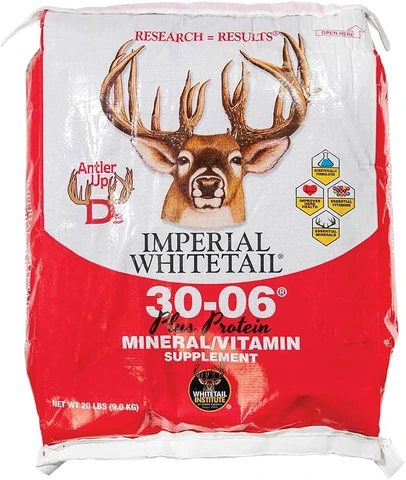
Best for: A landowner establishing ground sites in spring who wants protein alongside the minerals.
- 10 Percent Protein Boost: added on top of the mineral and vitamin base.
- 20 lb Bag: sold as the Plus Protein version in that weight.
- Ground Site Format: raked or shoveled into an area 2 to 3 feet across and mixed with the soil.
- Seasonal Formula: built for the 2 seasons when antler and fawn growth happen.
- Scent and Flavour Attractants: included to draw deer to the site.
Pros:
- The protein addition gives the site purpose beyond straight mineral attraction.
- A 2 to 3 foot worked area is quick to prepare with hand tools.
- Formulated around the spring and summer window when does and bucks both need it most.
Cons:
- Ground-site products need reapplication, so this is a seasonal commitment rather than one trip.
- The bag does not publish a full mineral analysis, so the ratios are the manufacturer’s claim.
- It has to be mixed into soil, which rules out a frozen or flooded site.
Rake in the Whitetail Institute 30-06 on Amazon
2. Trophy Rock by Redmond All Natural Deer Mineral Salt Lick, 12 lb
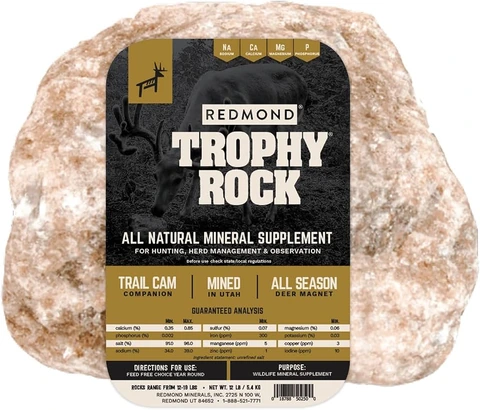
Best for: A landowner who wants a permanent lick with no measuring, mixing or raking.
- 12 lb Natural Rock: a solid mined block rather than a manufactured mix.
- 60+ Trace Minerals: the 60-plus nutrient count stated by the brand.
- Mined in Utah: a single-source natural product, not a blended formula.
- Place and Leave: set 1 rock down and let rain and deer do the rest.
- 1 Camera Station: a fixed point of attraction that keeps a camera busy.
Pros:
- Nothing to prepare, which suits ground you visit rarely.
- A solid rock survives weather that would wash a powder away.
- A single natural source is easy to explain to a lease partner or a landowner.
Cons:
- Salt is the draw here, so deer traffic may reflect sodium rather than a mineral deficit.
- The 60+ nutrient count is a brand figure with no analysis printed on the bag.
- It is a slow-release format, so it will not fix a soil shortfall quickly.
3. Evolved Habitats Deer Cane Powder Mix, 6.5 lb
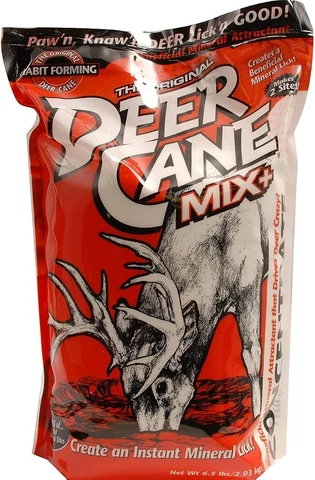
Best for: A landowner who wants a working mineral site established in a single afternoon.
- 6.5 lb Powder: a concentrated mix designed to cover a prepared site.
- 10 ft Site Diameter: the total area the directions call for.
- Two Sites Per 100 Acres: the spacing the brand recommends for coverage.
- 4 ft Clearing: debris cleared and soil loosened before the powder goes down.
- 6 to 8 Gallons of Water: the optional mixing volume for an instant liquid application.
Pros:
- Reacts with ground moisture, so the site starts working immediately after application.
- Clear, numbered directions that remove the guesswork for a first site.
- A powder covers more ground per bag than a block or a rock.
Cons:
- It must be worked into loosened soil, which is real labour on rocky ground.
- Sandy sites leach the minerals faster, so a light soil needs more frequent visits.
- Once established it still needs refreshing through the season.
Kick off a Deer Cane site on Amazon
4. Antler King Trophy Deer Mineral, 20 lb
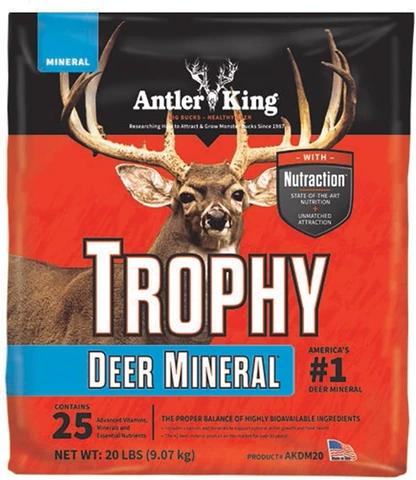
Best for: A landowner who wants a broad mineral and vitamin profile in one granule bag.
- 27 Minerals and Vitamins: major minerals, trace minerals, vitamins and amino acids.
- 20 lb Granule Bag: 320 fluid ounces, apple flavoured and built for ground application.
- Chelated Minerals: a form chosen for digestibility, with 20 lb in every bag.
- Yeast Culture: included to support digestion efficiency.
- Stackable Formula: designed to pair 1 bag with 1 bag of Power Rack for antler season.
Pros:
- Chelated minerals are a genuine formulation choice, not just a label word.
- The yeast culture addition is unusual at this price point.
- It stacks with a companion product if you want to build a fuller program.
Cons:
- The bag advises checking local baiting laws before use, which tells you the product attracts.
- The 27-mineral count is a brand statement without a printed analysis.
- Building a full program means buying two products, not one.
Load the Antler King Trophy on Amazon
5. Ani-Logics Outdoors Mineral Dirt 180, 20 lb
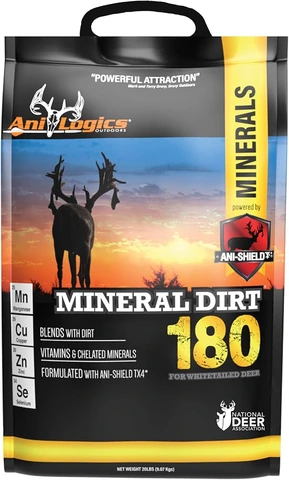
Best for: A landowner on open ground where rain would wash a powder site out.
- 20 lb Granular Bag: a mineral and vitamin supplement in granule form.
- 3 ft Circle Application: half the bag worked into the topsoil, the rest poured on top.
- Moisture-Resistant Formula: a 20 lb granule bag built to hold up to heavy rain better than salt-based mixes.
- Ani-Shield TX4: the brand’s long-lasting attraction component.
- Single Bag Per Site: one bag establishes one prepared site.
Pros:
- The moisture-resistant claim matters on exposed sites with no canopy.
- Granules resist wind better than a fine powder during application.
- It has a clear, simple site recipe that a first-timer can follow.
Cons:
- Nothing is printed about the mineral analysis beyond the marketing language.
- It still requires a prepared, loosened site rather than a drop-and-go approach.
- Reapplication is needed to hold deer on the site across seasons.
Work in the Ani-Logics Dirt 180 on Amazon
6. Domain Outdoor Recharge Deer Mineral, 10 lb
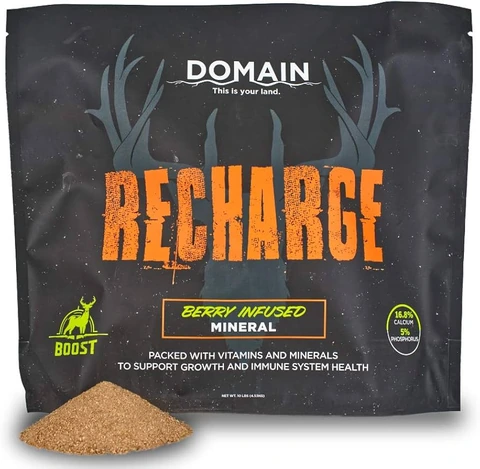
Best for: A landowner with a small property who does not need a full 20 lb bag.
- 10 lb Bag: half the weight of the 20 lb bags in this category.
- Berry Flavour and Aroma: an added scent profile to pull deer to the site.
- Powder Form: 1 bag applied to the ground as a mineral supplement.
- 3 Named Actives: vitamin A, vitamin E and zinc, listed on the label.
- pH Range 5.8 to 7.0: the 1.2-point band the brand lists for its use.
Pros:
- A 10 lb bag suits a small property or a single site without waste.
- Naming vitamin A, E and zinc is more disclosure than most bags offer.
- Berry scent gives the site an attraction component beyond the minerals.
Cons:
- Only the three named actives are disclosed, so the full profile is unknown.
- A scent additive may attract deer in the short term without fixing a mineral gap.
- A lighter bag means a lighter mineral load per site.
Recharge a site with Domain on Amazon
7. Big Tine Fortified Deer Block, 20 lb
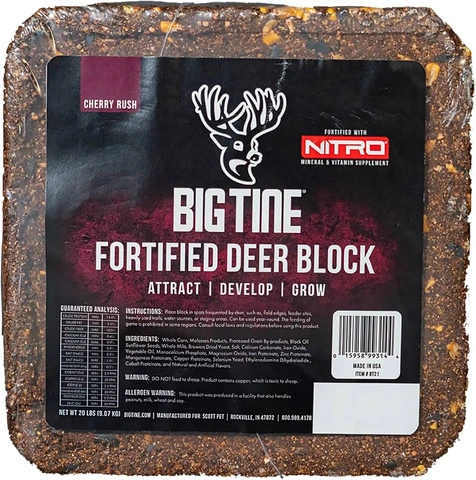
Best for: A landowner who wants attraction and feed in a single block that lasts.
- 13 Percent Protein: the stated protein level in the block.
- 5 Percent Fat and 10 Percent Fiber: a published balance rather than a vague claim.
- Corn, Black Oil Sunflower and Milo: the grain base carrying the minerals.
- 20 lb Block: set 1 block out whole, with nothing to mix or rake.
- Year-Round Use: 12 months of feeding according to the manufacturer.
Pros:
- The only product here that publishes a full protein, fat and fiber breakdown.
- Grain content gives it drawing power beyond the mineral load.
- A block takes a minute to place and cannot be spilled in transit.
Cons:
- This is a feed block first, so the mineral content is a fraction of a dedicated mix.
- Grains on the ground can draw turkeys and raccoons that empty a site fast.
- It dissolves at a rate you cannot control once the weather turns wet.
Stake out the Big Tine Block on Amazon
Frequently Asked Questions
Q1: What does the best deer mineral supplement actually do for a herd?
A: It supplies minerals that the local soil and browse do not provide in quantity, and it concentrates deer traffic at one spot you can watch. Sodium is usually the immediate draw, followed by calcium and trace minerals the deer seek. What no bag can deliver is antler size, because that depends mostly on age, year-round nutrition and genetics. Buy a mineral site for herd support and scouting convenience, and treat the antler language on the packaging as marketing.
Q2: Is a powder, granule, block or natural rock better?
A: It depends on how often you visit the property. Powder and granular products are worked into loosened soil and give the fastest, widest coverage, but they need reapplication through the season. Blocks and natural rocks are place-and-leave items that suit ground you see rarely. On a property you visit monthly, a raked granular site is the better choice. On a lease you see twice a year, a rock or a block will still be working when you get there.
Q3: How many mineral sites do I need on my property?
A: Evolved Habitats recommends two sites per 100 acres, and that is a reasonable starting point for most ground. Space them away from roads and property lines, put them in shade near active crossings, and keep them apart so a single dominant doe group does not control every site. Add a camera to each one, because the traffic record is the most useful thing a mineral site produces. Increase the count only if you have the acreage to justify it.
Q4: Do mineral sites count as baiting?
A: In several states yes, at least during some part of the season, which is why Antler King prints a warning about local game laws on its own product bullets. Rules vary widely: some states restrict baiting only during the hunting season, some restrict it within a set distance of a stand, and some permit mineral sites year-round with no hunting over them. Check your current state digest before you establish a site, and keep the site away from any stand if the rule is unclear.
Q5: How long does a mineral site take to start working?
A: Often within days for attraction and weeks for steady traffic, depending on how active the ground already is. Deer Cane states that its mix begins working immediately once applied and activated by moisture. A block or rock takes longer to draw the first deer because there is no scent plume, but it also lasts longer. The real test is a camera: if you see the same deer visiting regularly after two to three weeks, the site is established.
Final Verdict
If you want the best deer mineral supplement that tells you what is in the bag, don’t overthink it—these are already:
✔ Format stated plainly, so you know whether to rake it or drop it
✔ Bag weight and site directions given before the marketing language
✔ Attraction kept separate from any claim about antler growth
Best Overall – Whitetail Institute 30-06 Mineral and Vitamin Supplement, Plus Protein, 20 lb
Best Natural Rock – Trophy Rock by Redmond All Natural Deer Mineral Salt Lick, 12 lb
Best Powder – Evolved Habitats Deer Cane Powder Mix, 6.5 lb
Best Feed Block – Big Tine Fortified Deer Block, 20 lb
