
Whether you need hunter education to hunt deer depends on three things: the state where you will hunt, your age, and in many states your birthdate. There is no single national rule. Each state wildlife agency sets its own requirement, so the answer for a hunter in one state can be different from the answer for a hunter two states over.
Most states do require a hunter education certificate for first-time license buyers under a certain age or born after a certain date. Some require it for everyone who has never held a hunting license. A few offer ways to hunt before you finish the course. This article covers who must take the course, what the exceptions look like, how courses are delivered, and how to confirm your own state’s rule in about ten minutes.
The short answer: it depends on your state, your age and sometimes your birthdate
States write the requirement in one of two ways. Some say anyone who has never completed a hunter education course must do so before buying a license. Others set a cutoff: hunters born on or after a certain date must have the certificate, and older hunters are treated as already qualified. The cutoff date differs by state, so a rule you heard from a friend in another state may not apply to you.
Age matters in a separate way. Many states set a minimum age to take the course, and others set a minimum age to hunt at all. Youth hunters often have their own rules, including supervision by an adult.
Because of this, “do I need it?” is really three questions:
- Does my state require hunter education for a first-time deer hunter?
- Does my age or birthdate change that?
- Is there an exemption or a mentored option that fits my situation?
Who usually has to take hunter education, and who may be exempt
The people most often required to complete the course are first-time hunters, especially younger ones, and anyone who falls on the newer side of the state’s birthdate cutoff. Adult beginners are included in many states. Being an adult does not, by itself, excuse you from the course.
Exemptions exist, but they vary and they are narrow. Common examples include:
- Hunters born before the state’s cutoff date.
- Active-duty or former military members, in some states.
- Landowners hunting their own property, in some states.
- Hunters who hold a license from a previous year in a state that grandfathers existing license holders.
- Hunters using an apprentice or mentored license, covered in the next section.
Treat that list as a set of questions to ask, not a promise that any of them applies where you live. Exemptions are written into state regulations with conditions attached, and the conditions are what decide whether you qualify. Read the exact wording on your state agency’s page.
One more point: the requirement is usually tied to buying the license, not just to carrying a firearm in the field. If you cannot show a certificate or a qualifying exemption at the license counter or online checkout, the sale may be blocked. That is why it is worth settling this question before you plan a hunt around opening day.
Apprentice and mentored hunting: hunting before you finish the course
Some states let a new hunter hunt for a limited time without the certificate, as long as an experienced hunter goes along. These programs go by names such as apprentice license, mentored hunting, or hunter education deferral. They exist so a beginner can try hunting before committing to a course.
The details differ, but the common features are:
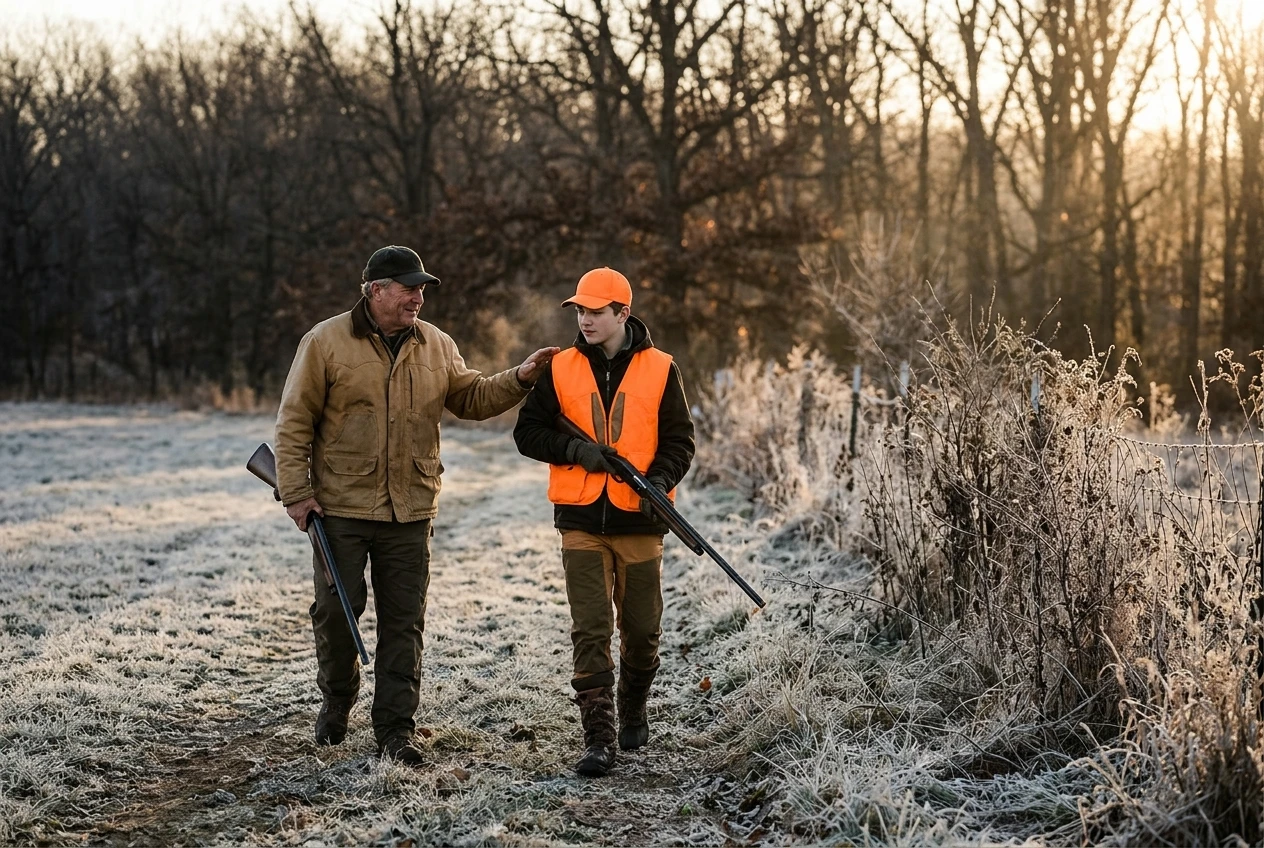
- The mentor must be a licensed adult, and many states require the mentor to have completed hunter education or be experienced.
- The mentor usually has to stay close enough to take over, sometimes within arm’s reach for firearm hunters.
- The apprentice license may be limited to a set number of years or a set number of times you can buy it.
- Some states restrict the number of firearms or the number of hunters one mentor can supervise.
If you plan to hunt with a friend or relative in your first season, this can be a practical route. It does not remove the requirement permanently. In most states, you eventually complete the course if you want to keep hunting. If you have no mentor available, the standard course is the more dependable plan.
Online course or field day: how the options usually work and what to ask before you pay
Hunter education is delivered in a few formats, and states choose which ones they accept.
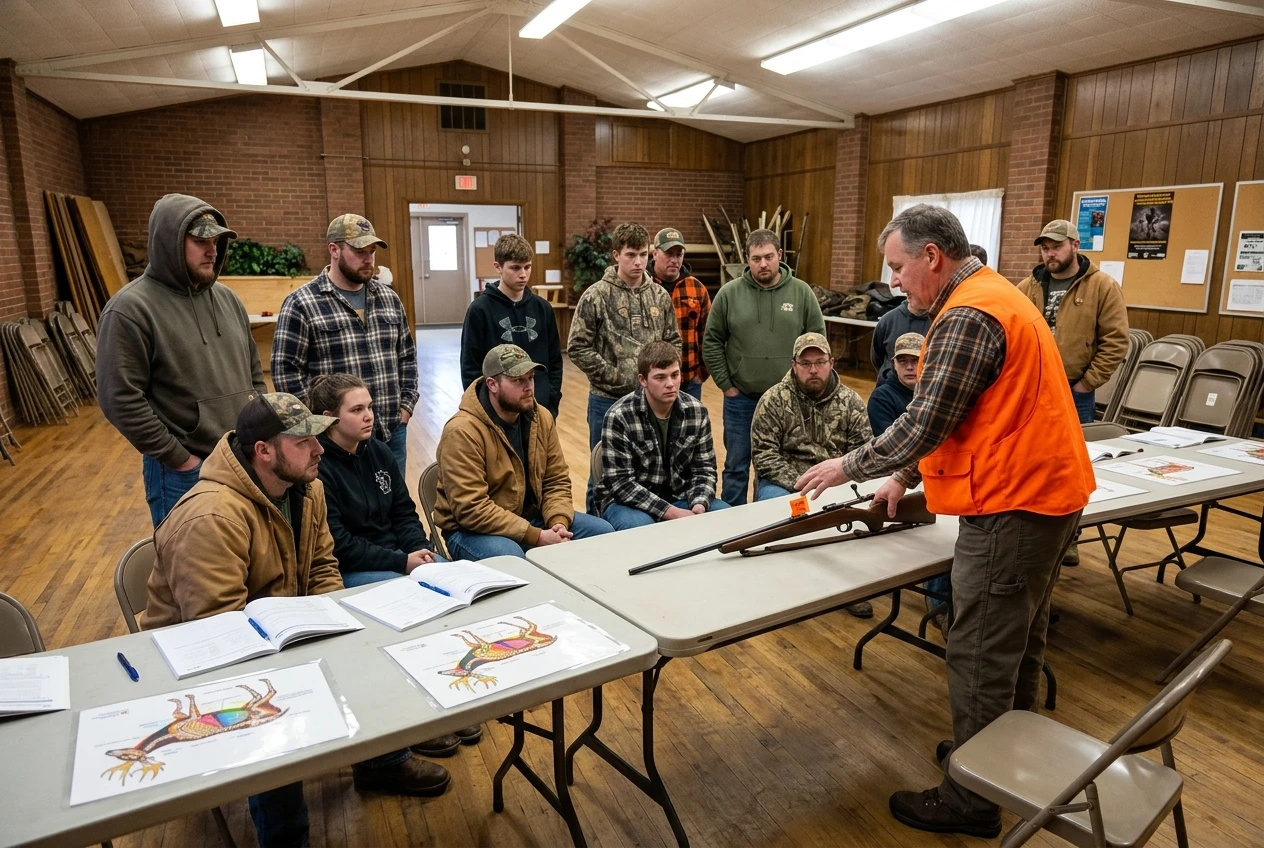
In-person classes. These run over one or more sessions with an instructor, and often include a live-fire or handling segment. They tend to suit people who want to ask questions and handle equipment with someone watching.
Online course plus field day. You complete the lessons on your own schedule, then attend a hands-on session or pass an in-person skills check. Many states use this hybrid format.
Fully online. Some states accept an online course and exam with no in-person component, sometimes only for adults or for certain age groups.
Before you pay anyone, ask these questions:
- Does my state agency accept this exact course provider? Several private companies sell online courses, and only the ones your agency approves will produce a valid certificate.
- Is there a field day, and when are the next ones? Sessions can fill up, and the schedule may not line up with the season you have in mind.
- What does it cost, and who collects the fee? Prices vary by state and provider, and some in-person classes are free or low cost.
- Will I get a certificate I can print or show on my phone, and how do I replace it if I lose it?
- Is there a separate bowhunter education requirement if I plan to use a bow? Some states have one, and it is not the same course.
The safest way to avoid paying for a course that does not count is to start from your state agency’s hunter education page and follow its links to approved providers, rather than starting from a search ad.
Hunting in another state: does your certificate travel with you?
In general, states recognize hunter education certificates issued by other states, and often by Canadian provinces, because the courses follow shared standards. That means a certificate you earn at home usually satisfies the requirement when you buy a license somewhere else.
Usually is not always. Some things to check when you plan an out-of-state hunt:
- Whether the destination state accepts your certificate as issued, or asks for a specific form of proof.
- Whether the destination state has an extra requirement of its own, such as bowhunter education for archery seasons.
- Whether your certificate was an online-only course, which some states accept and others do not.
If you are a nonresident, look at the nonresident section of the destination state’s agency site, since rules for visitors can differ from rules for residents. Keep a copy of your certificate with you, on paper and on your phone.
How to confirm your state’s rule in ten minutes, step by step
- Find your state’s wildlife agency. Search for your state name with “fish and wildlife,” “game commission,” or “department of natural resources.” Check that the web address is an official state government address.
- Open the hunter education page. It is usually under a menu called Hunting, Education, or Licenses.
- Read the requirement statement. Look for wording about age, birthdate, or first-time buyers. Write down the cutoff if there is one.
- Check the exemptions. Read the list line by line and compare it to your situation.
- Look for an apprentice or mentored program. Note the age limits, mentor rules, and how many times you can use it.
- Compare course formats and dates. Check the next field days or classes against the opening day of the deer season you want.
- Ask if anything is unclear. Most agencies list a phone number or email for hunter education staff. A short call beats guessing.
Save the page or take a screenshot of the requirement. Rules are updated, and you will want to see exactly what it said when you checked.
What to do once you have your certificate: where licenses and tags come next
The certificate is proof you can buy a license. It is not the license. After you finish the course, you still need the license itself and a deer tag for the season and method you plan to use, and those have their own deadlines and rules. Keep your certificate number handy, because the license system often asks for it at checkout.
Your first season involves more than paperwork, from scouting to getting the deer home. Our guide to your first deer season, step by step shows how those pieces fit together once the requirement is behind you.
Tools for hunting regardless of the state
Some preparation applies wherever you hunt, and most of it is cheap:
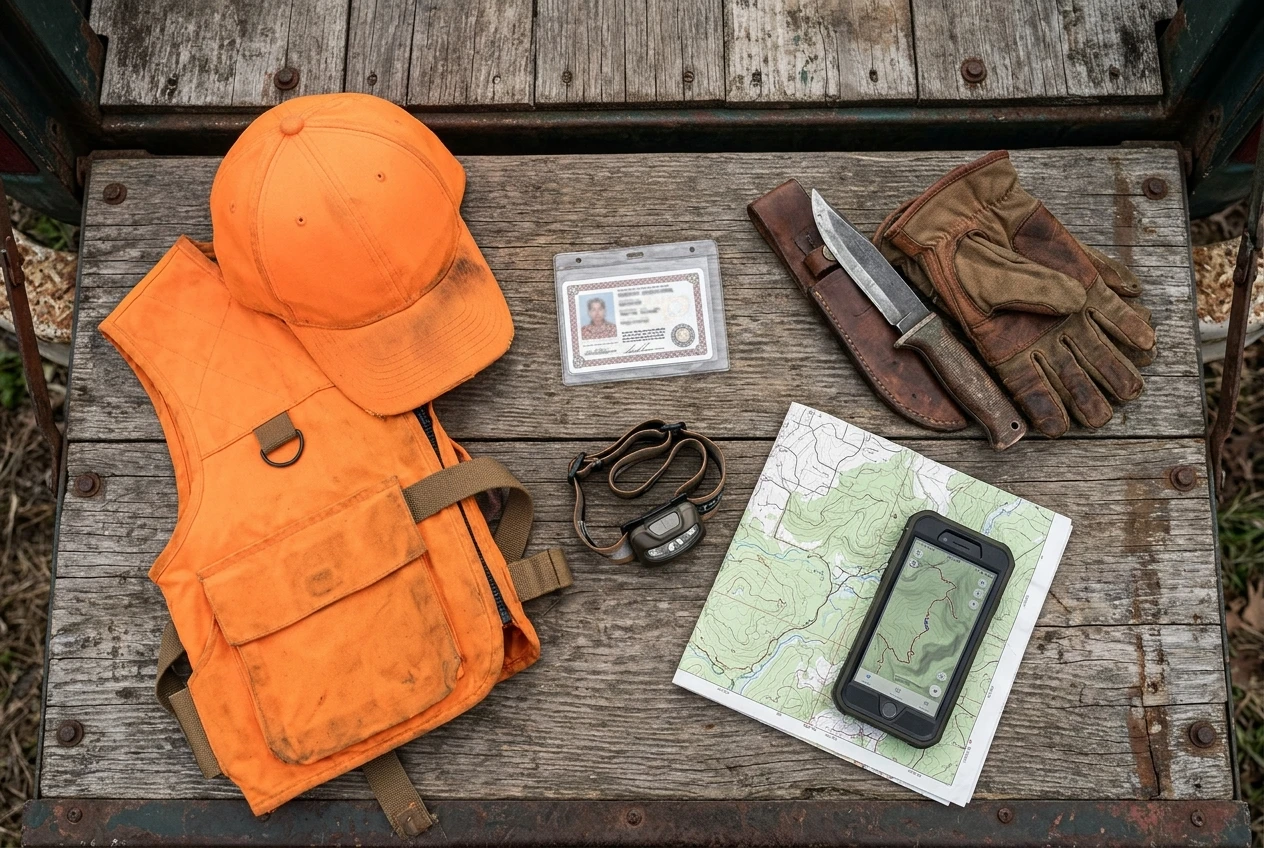
- Your certificate, in two forms. Keep a printed copy in your hunting pack and a photo on your phone.
- Blaze orange. Many states require a minimum amount of it during firearm seasons. Check your state’s rule, and wear it even where it is optional.
- A reliable knife and gloves. You will need them for field dressing, and a sharp knife is safer than a dull one.
- A headlamp with spare batteries. Hunters often walk in before daylight and out after dark.
- A map app or GPS and a paper map. Public land boundaries and your stand location are easy to lose track of in unfamiliar woods.
- A bookmarked agency page. Keep your state’s regulations page on your phone for season dates, legal hours, and tagging rules.
Gear choices get more specific once you know your season and method, and we cover them separately.
Frequently Asked Questions
Can an adult beginner skip hunter education?
In many states, no. Adult first-time hunters are often required to take the course. Some states exempt hunters born before a cutoff date, and some offer apprentice licenses, so check which of those applies to you.
Can I take hunter education entirely online?
It depends on the state. Some accept a fully online course, some require an in-person field day after the online lessons, and some require in-person classes. Your agency’s hunter education page lists the formats it accepts.
Does my certificate expire?
Hunter education certificates generally do not expire, but confirm this with your agency. If you lose yours, the state that issued it can usually provide a replacement.
Do I need hunter education to hunt on private land?
Sometimes the license requirement still applies on private land, so the course may still be needed. A few states have landowner exemptions. Read the exemption wording for your state rather than assuming.
Do I need a separate course for bowhunting?
Some states require bowhunter education in addition to hunter education for archery hunters, and others do not. Check the archery section of your state’s regulations.
So, do you need hunter education to hunt deer?
In most states a first-time deer hunter does, with exceptions based on birthdate, military service, or an apprentice program. The only answer that counts is the one on your state wildlife agency’s website, and you can find it in about ten minutes.
Once you know your hunter education requirement, read our walkthrough on getting your license and tags, then see what gear you actually need for your first season.